Former French PM condemns Israel's war on Gaza - Dominique de Villepin & Fatima Bhutto | Studio B
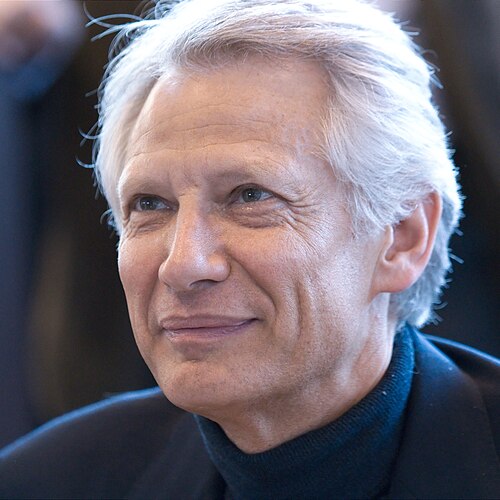 Dominique de Villepin
Transcription Whisper (large-v3), avec identification des locuteurs. À recouper avec la source d'origine.
Analyse automatique
Générée par IA — peut contenir des erreurs. Méthodologie
Chapitres
Répartition du ton (temps de parole politique)
Propositif 35 %Attaque 45 %Défensif 20 %
Questions et réponses
Taux de réponse directe : 100 % (directe = 1, partielle = 0,5, éludée = 0)
- 1:28OuverteRéponse directe
Pourquoi avez-vous pris la parole sur la guerre à Gaza, que vous avez qualifiée de plus grand scandale historique ?
- 3:56OuverteRéponse directe
Quels sont selon vous les objectifs militaires et politiques d'Israël dans cette guerre ?
- 7:10OuverteRéponse directe
Netanyahu reprend-il là où les États-Unis ont laissé après le 11 septembre ?
- 9:40OuverteRéponse directe
Qui peut jouer un rôle pour faire avancer une solution ?
- 13:39RelanceRéponse directe
Pourquoi l'Europe ne dit-elle pas à Israël de stopper cette guerre ?
- 14:41OuverteRéponse directe
Quelles mesures concrètes la France pourrait-elle prendre qu'elle n'a pas encore faites ?
Temps de parole
- Dominique de Villepin72 %
- ?14 %
- Présentateur14 %
≈ 96,3 interruptions / 10 min (chevauchements et interjections détectés).
Modèle mistral-small-latest · prompt v1 · les citations sont vérifiées mot pour mot dans le transcript ; le taux de réponse directe est calculé à partir des verdicts question par question. Aucun label idéologique n'est produit.
It is the indifference, it is the inhumanity that is fueling violence. The world should start recomposing the new world order, starting with Palestine, which is the strongest symbol of justice.
Since
his historic speech at the UN Security Council, declaring France's opposition to the US invasion of Iraq, former French Prime Minister Dominique de Villepin has been an
outspoken critic of Western military interventions
around
the
world.
My
name is Fatima Bouteau, and in this special interview for Studio B, I'll be talking to Dominique de Villepin about the war on Gaza and why he believes the international community has failed to act.
Thank
you, Dominique de Villepin.
You
are the most high-profile Western politician, a former foreign minister and prime minister of France, to have spoken out on the war on Gaza, which you called the greatest historical scandal. Very simply, what compelled you to add your voice to this issue?
Well,
there are many personal reasons. I was born in Morocco. My family lived in Algeria. I went through decolonization. I was raised in South America, lived in the U.S., in India,
and
traveled extensively around the world.
And I
really could not stand
looking
at
such
a suffering, such a waste
in
the Middle East.
during
the 7th of October,
a
tragedy for Israel,
and
every day since,
for
Gaza, now Lebanon,
and
who knows elsewhere.
And
I keep asking myself,
where
is it going to end?
And
it is true that at first you can convince yourself
that
Israel had many reasons
to
restore deterrence,
many
reasons to secure its own population. We can understand that.
But
why
destroying the
whole Gaza?
Why
killing children, women? Why this determination
to
destroy schools, universities,
even
cemeteries?
The
whole identity
of
the Palestinian people.
And
that's where you understand that you are in front of an escalation that nobody does control. And I cannot accept the fact
that
the world leadership, neither in the Arab world, neither in Europe, neither in the U.S. or elsewhere,
can
stand still
and
not do anything. We know that the war and terror should not be fought through only force. We need political objective. We need hope at the end of the day.
And
there is no hope
until
today.
We
know that the destruction has been total. According to the UN, Israel has killed more five to nine-year-olds than any other age group in Gaza.
It's
been an attack on doctors, on journalists. What do you think Israel's military and political objectives are in this case?
I
think the common justification of Israel is
both security
and retaliation towards a terrorist movement, which is Hamas.
I
think
anybody
looking at what's going on in Gaza sees a huge disproportion between the retaliation
and
the threat. Even
the
former Minister of Defense, Yoav Galant, says
that
Israel has reached
its
objectives in Gaza.
So
why the war is continuing?
Is
it because Benjamin Netanyahu wants to make a gift to Donald Trump as a new president and wait a couple of months more
and
not give this gift to Joe Biden?
Is
it because there is some kind of a hidden agenda
pursuing the
destruction of Gaza
and
the possible colonization of Gaza or the displacement of the population? And that's why I want to remind every leader of the world, international law is for everybody.
Even
for the most developed country, there should not be double standards. We should not forget
that
at the core source of all this violence,
there
is something that happened in this region, which is the whole population of Palestine having to leave their homes.
I
remember my friend Mahmoud Dawish, the poet,
telling
me his feeling
when
he has and his family
to
leave everything, 700,000 people leaving their homes
with
no possibility of going back. This feeling, the Nakba, the catastrophe, is very much in the mind of the Palestinians as much as
for
the Israelis, the Shoah, the pogroms of the end of the 19th century, is still very present. These trauma are here.
But
this injustice
is
today on our shoulders.
There
will be no peace. There will be no security in this region
until
we can erase this injustice and recognize a Palestinian state.
And
this, everybody has to understand it. Donald Trump, as much as the European leaders, as much as the Arab leaders, some people think that in the hidden agenda of some of these countries, they are happy to see the liquidation of terrorist organization. Yes, but nobody would be able
to
liquidate, to erase
the
Palestinian requirement for justice.
In your speech at the United Nations Security Council in 2003 against the Iraq war, you warned then that the credibility of the West was at stake. Is Prime Minister Netanyahu picking up where the U.S. left off after 9-11?
I
think that Benjamin Netanyahu
is
very much using geopolitics to his own personal benefit. He has very much in mind the idea that for Israel it would be a lot easier
if
it could legitimate what the current Israeli government is doing every day
in
putting forward
the
risk of a clash of civilizations.
Of
course, if you say there is a risk of civilization and Israel is at the forefront, Israel is fighting
as
Benjamin Netanyahu says,
fighting for Europe.
And
President
Herzog
as well. Yes,
fighting for the U.S. to defend civilization.
But
how can you defend civilization
not
respecting humanitarian law, not respecting human lives, not respecting the necessity of justice? Civilization is two things. It's an inheritance of culture. It's an inheritance of duties. But it's also the ability to take the lessons from history and the lessons that we should take from the last 25 years since 9-11, the war on Afghanistan, the war in Iraq, the war in Libya, and so on, is that there is no way you can erase terror just by force. You need a political perspective. And I'm still waiting every day
for
somebody to stand up in Israel and say, OK,
we
have
obtained
what we wanted.
We
have erased Hamas. We have dismantled the Hezbollah. Now, let's give a perspective to the Palestinian people. Let's make sure that Lebanon will be able to reconstruct. Let's give hope to these people. You see, the best proof
of
madness of this region is that, as today,
so
little empathy in Israel for what's going on in Gaza.
And
on the side of the Arab, so little empathy for what happened on the 7th of October. Empathy is the precondition for humanity.
But
in this case, who can step in to play a role? Because we've seen the West either reluctant or simply unwilling, unprepared to step in to exert any pressure on Israel. In the case of the US, now with President-elect Trump's arrival, and with his cabinet and his advisers who are even more overt in their support for the occupation, where are
we
going to see solutions come from?
We
are in a moment
very
important for the world
because
the world is broken and every day more divided. Divided between the West
on
the defensive
and
emerging countries. We've seen that in the summit of Kazan with Russia, China, the BRICS,
which
are
organizing
themselves in a more and more polarized world. So we are at a turning point. And that's where Donald Trump comes.
And
Donald Trump is a man
totally
impredictable. This brings
both
a liability, a responsibility, but also an opportunity.
The
opportunity is that we know for sure
that
Donald Trump wants to put back on the agenda, the Abrams Accord.
He
wants to look at the region on a transactional
way.
Economic, technology,
betting
on the strong countries, Israel, Saudi Arabia, trying to solve the Iranian matter.
So
the question now,
in
the next two months,
is
a window of opportunity
for
the region as well as for Europe
to
get together, united, and to send two messages.
The
first one, we are united.
And
there is no way
we
are going to accept any deal
unless
we go for
a
Palestinian state. Saudi Arabia now is in a position of leadership in this region.
strategic
leadership, political leadership, religious leadership.
So
there is the position of Saudi Arabia because Saudi Arabia is at the center of the agenda of both Israel and the U.S. They are betting on Saudi Arabia
to
create an axis of stability
and
Saudi Arabia accepting the Abrams Accord.
And
of course for Europe,
for
Europe,
which
has fought
for
many, many decades for the two-state solution.
It
is a fantastic opportunity to put their weight
to
support the Arab countries.
But do you think that the Palestinian people, because they are largely absent in this process so far, do you think the Palestinian people have any faith in Saudi Arabia as a negotiator for peace?
I
think that
it
is a process. We should create the possibility of a new governance for the Palestinians.
We
should create a process for a new governance in Gaza. We should have a clear perspective of unifying Gaza, the West Bank and East Jerusalem. So it is a process of responsibility. We know that the Arab countries are ready with the support of the U.N. to create an interposition force. We know that they are ready to participate to the next administration of Gaza. But we know at the same time that Israel is preparing everything in Gaza to take over the control of the region. The Nectarine Corridor, the Philadelphia Corridor, a buffer zone around Gaza. At one point, we should say stop to Israel.
And so why doesn't Europe tell them to stop? 13, 14 months in. Why hasn't a
single
European country done that?
I think the European should get united. They will have to do so just to defend their own economic situation. They should do it on the basis of justice. And we have another reason to support such a strategy.
The
fact that
the
world order of 1945, the world order is dying because it is an unfair order. It is criticized by all the BRICs, by all the emerging countries, by all the poor countries of Africa, South America. It's time
to
recreate a new order. And my profound belief
is
that the world should start recomposing the new world order, starting with Palestine, which is the best and strongest symbol of justice.
So what could France, for example, do in concrete measures that they haven't done so far? Because we've heard some pushback from countries like Spain, for example. But in terms of actual steps, what
can we do? I think the one thing
that the Europeans could do
would
be collectively
to
launch the movement of recognition of Palestine as a state. President Macron said we favor such a movement, but it is not the right moment.
But
I'm asking, what is the right moment? I think it is an incredibly important move. Why? Because we see the despair in the region. And my profound belief is that if we don't do nothing, then at the end of the day, we will see
terrorist
movement taking the advantage, using the revolt, using the anger of the region to relaunch new attacks. I think we should put at the starting point the creation of Palestine as a nation state just to show the Palestinians that we are serious, we are committed, and then
do
the real and difficult work.
So
when you talk of a Palestinian state, are we talking about a state that would be on 22% of what was historic Palestine?
I think that
if
you are a young Palestinian,
the
question is not so much the size. You see, ideology has been dominating the region for decades, since 1948.
At
one point,
if
you are a Palestinian, what do you want? You want a future.
You
want a home.
You
want the possibility of having a sovereign country. this is what you want. Very concrete things. So, of course, the Hamas will say, no, we don't want that.
And Israel, presumably.
And, of course, Israel. And the Hamas and other terrorist organizations will say, no, what we want is to eradicate Israel. That's ideology. And one of the biggest dangers for the region is that what used to be a political issue, the question of Palestine, is today more and more a religious issue. And we know that when those issues are put on a religious basis, there is no end. No end to hate. No end to violence. So, we should be careful
in entering
in the deep
subject
of
creating
a future for the Palestinians and the possibility also for all the Arab world, which is very important, to try
to
begin to work together. The unity of the region, the solidarity in the region, the economic perspective. It is one of the richest regions in the world. And you have failed countries, poor people, a strong division between rich and poor. All this could be solved through a Middle East regional agreement. You could launch a new future for the region, starting with the principle of justice. And why Benjamin Netanyahu is putting so much energy
in
what he's doing? Of course, to save his own life. Yes. But also
because
he wants to eradicate, to erase the Palestinian question in order to realize what the maximalists in his government, the messianic
people
in his government, Benvir, Smoetrich, want, which is a great Israel.
Gaza
is the graveyard of more than just Gaza. It is the graveyard of international law, of the functioning of the UN. So if Israel has gotten away with this disproportional violence, what can the West do to Israel to make them accept even the idea of a Palestinian state?
I think
that diplomacy is a way to use the balance of forces in order to create new opportunities. If the Arab-Muslim countries of the region
get
united, if they were together with the Europeans
to
show
to
the United States that there is a red line,
you
should remember in
2018, Donald
Trump advocated
the
transfer of the capital from Tel Aviv to Jerusalem. He defended in 2020 the Abrams Accord. He supported a peace plan with no perspective for the Palestinians. So he's capable to pressure Israel in a way Joe Biden was not able to do.
He
wants
to
put his marks in history.
So
he's transactional.
if
we put as a red line the necessity of the creation of a Palestinian state, if Saudi Arabia
accepts
to stand for this idea, then everything would be possible.
In an interview with The Atlantic, though, which was denied later on by Saudi authorities, MBS was reported to have said that he personally didn't care for the Palestinian issue, that his people did, but not him. Said Rehber later denied that. Isn't it very risky to put the fate of Palestine in the hands of Donald Trump?
There
is no blank check here.
There
is the fact that
we
know for sure
if
we are not going to take the opportunity to create the Palestinian state today, situation will get worse in the region tomorrow.
You
see,
when
you try to put into perspective
the
capabilities of this region in terms of disruption, we should remember in 1973, the same countries that decided to use oil and gas for embargo.
They
could decide to disrupt all
the
maritime corridors of the region and to disrupt international trade. They have the capacity for all the leaders of the region, even Northern Africa, Algeria, South Africa, who have been fighting in the International Court of Justice. all this country, they have in their hand
a
historical responsibility.
And
if you don't take this responsibility, things will get worse. We had the 7th of October. Who knows what we will have tomorrow? And we know that not doing anything is going to fuel violence, to reinforce Hamas, to reinforce Hezbollah, to reinforce all these terrorist organizations. It is the indifference, it is the inhumanity that is fueling violence. And that doesn't mean that we should forget the situation in Sudan, the situation in Ethiopia, the situation in Congo, the situation in Ukraine. But a new world needs to start. a new world order needs to start through action.
And
action can start tomorrow
in
Gaza and in Palestine.
Dominique Duvillepin, you're a politician and a diplomat with over four decades of experience. And you recently said that the irony of history is that sometimes when we are at the bottom of the abyss, something happens that can allow hope. it certainly feels in many ways that we are at this bottom already. What exactly do you feel we must be hopeful about going forward?
Well,
I think there's
something
very basic that we need to do every day. Just look
at
those
little
children
of
Gaza.
What
future will they get?
Think
about those little children in the northern part of Israel or in the southern part of Lebanon. What future? Bombs, more bombs, violence, deaths. Is this the future we wish for these people? And to end up this vicious circle of violence, we need to restart everything.
And
the world is going to fall apart. Globalization is going to fall apart. You see, all the people looking for getting richer,
that's
fine. but they won't get any richer if our world is going to be divided
in
one part the rich countries of the West, another part the countries of the global South with such a resentment that every day we will feel
even
inside our countries and in the rest of the world this danger as a threat to security and stability. And you see, there's something diplomats know well,
which
is the ruse of history.
The
last very important ruse of history has been
Russia
and China getting together. Nobody had thought before that this was possible.
So,
why tomorrow cannot we dream to have Saudi Arabia
and
Iran
getting
along one another
and
creating a new balance of forces in the region every time I go to the Middle East. I look to these people for decades, for centuries, they've been waiting for something to happen. And I see people getting richer in those countries, in the Gulf states, and I see the gap in between the people and the elites.
This
is not acceptable.
This
is a huge risk for the region. So, humanity, justice, realism, pragmatism,
this
should be on the agenda for all of us.
Well,
here's to a future of justice and peace. Thank you, Dominique de Vilpa.
Thank you so much, Fatima.
Thank you.