Conférence de presse de Jean-Noël Barrot à Munich
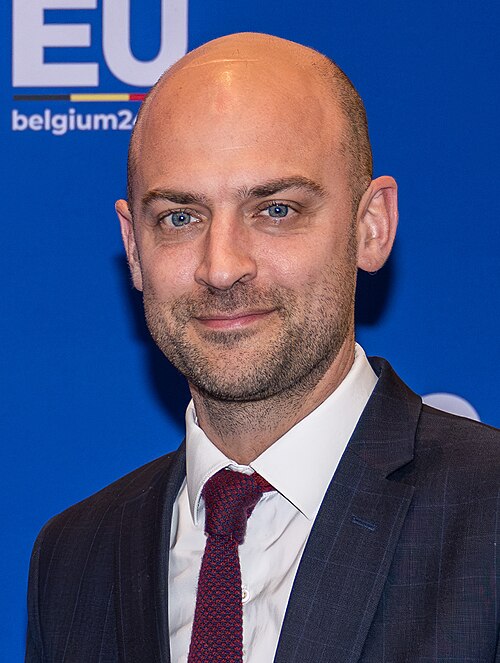 Jean-Noël Barrot
Transcription Whisper (large-v3), avec identification des locuteurs. À recouper avec la source d'origine.
Analyse automatique
Générée par IA — peut contenir des erreurs. Méthodologie
Chapitres
Répartition du ton (temps de parole politique)
Propositif 95 %Attaque 3 %Défensif 2 %
Questions et réponses
Taux de réponse directe : 88 % (directe = 1, partielle = 0,5, éludée = 0)
- 4:26OuverteRéponse directe
Quelle est la position de la France sur l'Alliance des puissances moyennes proposée par Mark Carney pour une Europe forte ?
- 9:02OuverteRéponse directe
Quelle est l'attitude de la France face à la réforme de l'ONU et du Conseil de sécurité ?
- 16:57FerméeRéponse partielle
Soutenez-vous la proposition d'un méga-tarif de 30% sur les importations chinoises ?
- 19:56OuverteRéponse directe
Le président consultera-t-il le Kremlin avant ou après les consultations européennes sur la sécurité ?
Affirmations vérifiables (citations exactes)
- 2:32Invité politiqueChiffre
« Arche qui a été frappée à l'hiver dernier par un drone russe occasionnant des centaines de millions d'euros de dégâts et un risque pour la sûreté nucléaire. »
Temps de parole
- Jean-Noël Barrot85 %
- ?7 %
- Invité2 %
- Invité 22 %
≈ 57,1 interruptions / 10 min (chevauchements et interjections détectés).
Modèle mistral-small-latest · prompt v1 · les citations sont vérifiées mot pour mot dans le transcript ; le taux de réponse directe est calculé à partir des verdicts question par question. Aucun label idéologique n'est produit.
Je viens
de présider la première réunion
des
ministres des Affaires étrangères du G7 sous présidence française, première réunion physique puisque nous nous étions parlé au moment de l'intervention américaine au Venezuela.
Une
présidence qui entend s'emparer, vous le savez, de la question des déséquilibres mondiaux et de leur réduction, de même que du renouvellement des partenariats avec les pays en développement, deux sujets qui figureront en bonne place des discussions que le président de la République accueillera à Evian les 16 et 17 juin prochains. Une présidence qui entend aussi jeter des ponts avec les autres grandes puissances, conjurer les logiques de bloc, ce qui m'a conduit d'ailleurs à inviter aujourd'hui l'Inde, grande puissance émergente qui préside les BRICS cette année, un groupe avec lequel nous voulons nous coordonner plutôt que nous affronter.
Et
puis une présidence qui entend obtenir des résultats concrets
au
service de la sécurité, mais aussi de la prospérité des pays du G7 et donc de la France et des Français.
En
somme, un G7 d'équilibre,
de
convergence et de résultats.
Aujourd
'hui,
nous
avons d'abord accueilli l'Ukraine qui a pu faire état de l'avancée des négociations, de même que de la situation énergétique.
Nous
sommes accordés sur la coordination dans la poursuite de notre politique de pression et donc de sanction sur la Russie, accordés sur la mobilisation en soutien à la résilience énergétique de l'Ukraine. Vous vous souvenez qu'il
y
a deux semaines, nous avons réuni un groupe qui s'appelle le G7
Plus
Énergie, à la demande ukrainienne pour mobiliser la communauté internationale,
qui
m
'a
d'ailleurs conduit à l'envoi de 150 générateurs sur place qui sont arrivés, et puis coordonnés sur l'objectif d'entraîner la communauté internationale à participer au financement de la réparation de l'arche de Tchernobyl. Tchernobyl, catastrophe dont nous allons marquer dans quelques semaines le 40e anniversaire, qui a fait l'objet d'une mobilisation par le passé du G7 pour que l'arche d'endiguement de la radioactivité puisse être construit. Arche qui a été frappée à l'hiver dernier par un drone russe occasionnant des centaines de millions d'euros de dégâts et un risque pour la sûreté nucléaire.
Nous
avons ensuite accueilli le docteur Jaï Shankar, ministre des Affaires étrangères de l'Inde, qui préside donc le groupe des BRICS cette année.
L
'Inde qui a récemment approfondi ses relations avec les membres du G7, dont nous nous sommes collectivement félicités.
L
'Inde avec laquelle, en tant que telle, mais aussi comme présidente des BRICS, nous voulons justement obtenir des résultats concrets, notamment sur la résilience des chaînes d'approvisionnement, sur la sécurité maritime et puis sur la réforme jugée indispensable et urgente des Nations unies par les pays du G7 comme par l
'Inde.
Dans un troisième temps, nous avons abordé les grandes crises régionales et internationales sur lesquelles nous sommes mobilisés. L'Iran, Gaza, la Syrie, le Liban, le Venezuela, Haïti ou encore le Soudan.
La
prochaine rencontre dans ce format se tiendra les 26 et 27 mars prochain à l'abbaye des Vauds-Cernay, dans les Yvelines, qui est matière d'élection.
Et
puis nous nous retrouverons à New York au mois de septembre, au moment de l'Assemblée générale des Nations unies et de la semaine de haut niveau. Puis nous nous réunirons enfin
à
Marseille les 9 et 10 novembre prochains.
Nous
nous réunirons d'ailleurs aussi souvent que nécessaire en visioconférence pour coordonner nos positions si nécessaire.
Ne
vous attendez pas à un G7 de la parole, mais à un G7 des actes, je le disais tout à l'heure, un G7 d'équilibre, de convergence et de résultats.
Est
-ce qu'il
y a
quelques questions ?
Hello,
thank you very much for your talk right now. I'm Katrina Horbein, security policy journalist from Berlin. I'm speaking in English, I hope that's okay. My question to you, President Macron said last night that it's time for a strong Europe, and Europe must turn its focus to long-term strategic thinking. In 2019, France and Germany founded the Alliance for Multilateralism. Mark Carney recently talked or suggested Alliance of Middle Powers. So my question to you, what is France's position on this? Are you open to starting such an alliance to finally get to this strong Europe and implement what President Macron said last night? Thank you.
So
yes, the vision we have is a stronger and more independent Europe. And this is a line that President Macron has defended over the past 10 years.
And
already we are seeing results.
We
are seeing results in the field of security with clearly the establishment of European defense, if I were to say it broadly, with financing instruments at the European level, with commitments at NATO and with other initiatives such as the coalition of the willing that was created by France and the UK, that brought together more than 30 countries in the world, which for the first time in their history, for some of them, have agreed to join a military planification exercise in response to a continental scale security issue, security guarantees for Ukraine. So if you go 10 years back, in terms of defense, Europe has clearly stood up. Now, of course, we need to go further.
And much of the discussions here in Munich this year were about that, how to go further, how to go further in terms of industry capabilities, how do we develop a strong European industrial basis, European basis.
And
as far as this is concerned, you know, how important European preference is in in our view. But I want to emphasize, like President Macron did last night, that European preference is not French preference. What we want is a truly and genuine European industrial basis. We want to see industry, the defense industry grow and develop in each and every country of Europe, because we want to be able to procure, to source some of our equipment in other European countries. And we want other European countries to turn to the European industrial and defense basis. That's the first pillar. The second pillar is coordination and governance.
Our American allies in NATO have expressed their intention and willingness to adjust their level of commitment. Recent decisions were announced where Italian and German military officials are going to take high level responsibilities within NATO. This is great. This is the European pillar of NATO that we've been vouching for. Let us not see the adjustment in our American allies strategy as a depressing news. It's an incentive to develop European vision and capacity within the alliance. It's a way to Europeanize NATO in some sense,
in
close coordination with them. And the third pillar that President Macron mentioned yesterday is security architecture. We are in the process of sort of reestablishing some kind of parity with some of the superpowers and in particular with our neighbor, Russia, that is now dedicating close to 40% of its budget to its military efforts and to its war of aggression against Ukraine, 10% of its national revenue. So we need to step up our efforts, and this is exactly what we're doing. As far as France is concerned, we're doubling our defense budget.
And
once we're there,
it's
our responsibility to draft the security architecture for the continent.
And
we need to, now that we have made the necessary decisions to scale up our efforts, we need to start thinking what kind of architecture we want for the continent
and
be ready when times come to start this demanding conversation.
Thank
you,
thank
you for the opportunity. I'm from Dragon TV, which is based in Shanghai, a city you have visited a year ago, right? So you have just finished your trip to Middle East, including Syria,
which
means France is engaging with the United Nations political mission.
But
this morning, Secretary Rubio said
United
Nations is playing no role on solving the conflicts.
So
what's your opinion, and what's France's attitude toward the future of
the
United Nations and something like a reform of the Security Council? This is the first question. The second question is about China and the EU. So during the process of EU is seeking strategic autonomy, so how do you see China's role? Do you see China as a rival or an essential partner? Thank you so much.
Thank
you for these two questions. I'll start with the first one to say that from the conversation we just had, I draw the conclusion that G7 members, but India alike, consider that the UN need urgent reform and that time is of the essence. Why? Well, because we're seeing international and regional crisis throughout the world, and there is a growing impression that the UN system, as far as peace and security is concerned, cannot provide full-fledged solutions. Everyone agrees that the UN are indispensable.
And if you've been like I've been, and like some of my colleagues have been, at the border of Sudan, where refugee camps hosting hundreds of thousands of people have fled persecution and deaths, you realize that without the logistical chains of the United Nations agencies, the situation would be untenable. It would be inhuman. It would be dire.
And
so from the conversation we had, there is a true willingness to address UN reform. And including in practical terms, I mentioned the logistical chain of the humanitarian mission of the UN. There is certainly progress to be made, and we will,
as
G7 chair, put on the table proposals to my colleagues and to other G7 members to improve the efficiency of these logistical chains.
We
will also
work
and make suggestions on how to reform our peacekeeping operations to make them more effective, etc., etc. But we will work, first and foremost, on the practical reforms that are needed to produce an effect on the ground. That is what
our
co-citizens are expected from us, and that's, I think, the focus of G7 members this year.
Now,
let me go one step further and talk about
the
political reform of the UN.
We
are seeing the difficulties that the Security Council is facing in enforcing international law and international humanitarian law.
France
sees the origin of these difficulties in two places. One is legitimacy, and the other one is efficiency. Legitimacy
means
that the Security Council needs to be enlarged to some of the countries and the regions that are today underrepresented in this group, in this forum.
And
this is why France has been pleading for this enlargement to include Japan, India, Germany, and Brazil, but also two African countries as permanent members of the Security Council with all associated prerogatives. And we will be working this year to try and push this agenda forward because we think it's necessary. In particular, we will seize the opportunity of the Africa Forward Summit that France will co-chair with Kenya on the 11th and 12th of May, 2026, to rally a number of countries around some of the, or to encourage some of the
countries
and our partners to the necessity to move forward with this enlargement reform that has been discussed for a long time now at the UN.
This
is legitimacy.
The
other point that I want to emphasize is efficiency. Too often now we're seeing situations of mass atrocities where the UN Security Council is not able to project force or to take action or sanctions. France and Mexico, a little bit over 10 years ago, witnessing the situation in Syria,
where
a UN action was paralyzed by Russian veto,
decided
to initiate a collective effort
to
push the permanent members to abstain from using their right of veto in the case of mass atrocities. 107 countries to date have signed
this
declaration.
With
my Mexican colleague, we're going to accelerate the efforts to rally signatures to this initiative. And I would like to be in a position, I cannot be sure for now, but I would like to be able to go one step further and table a tax resolution if the conditions are met before the end of the year.
Because
it's not about, you know, abolishing veto.
It's
about maintaining a reasonable use of veto
by, you
know, by bringing the permanent members to this state of abstention
of
veto when the world witnesses unbearable reality of humanitarian catastrophes
created
by mass atrocities.
And
then the second question was about,
yeah,
China and the
EU. We
had a very constructive discussion yesterday with Yuan Watful, the German minister, and Wang Yi, the Chinese minister of foreign affairs. We, you know, the EU position since 2019 with respect to China, a partner, a competitor, a systemic rival. Now we are, we are, we are,
we
need to
sort
of turn this, this tripod into action. And this is what we've been discussing extensively both within the EU, under the leadership of Kaya Kalat, but also with China when President Macron was there last time. So there are areas for convergence, but we, we, we have to open our eyes on the consequences of
what,
you know, of the spectacular economic performances on China, on the European economy, jobs, and, and, and, and, and, and
trade
performance.
So
we need to find some rebalancing. And that's why this rebalancing of, or this resumption of macroeconomic imbalances
is
so central in the French G7 presidency.
We
need two more questions.
Thank you. Hi, Anjanus von Bloomberg News. Just to bounce back on what you said regarding China, just to be clear, do you support a proposal by this
French
government think tank, Le Haut-Commissariat de Clément-Boune, to set up a 30% megatariff on China? What do you think of this idea? Would you back it?
Well,
Europe's responsibility is to pave the way for a third path.
And
this third path
also
has, you know, a economics and, and, and trade kind of dimension.
So
what we want is to find the conditions under which we can establish respectful partnerships with China and others. The fact is, as I was just saying, that the,
the
spectacular performances of China since COVID in particular, are creating a shock. A shock on the European industry and European jobs.
The
right way to go should not be to raise walls and to, and to, to fall into the trap of generalized protectionism.
And
that's why when President Macron was in China early December, he had a very candid discussions with President Xi Jinping to, to,
to,
to, to present the consequences of what we're seeing right now in, in Europe. And to call upon the Chinese authorities, to make an inflection in some of their policies. Open the Chinese markets to European exports, invest
in
Europe and consider accepting the principle of technology transfers, refrain
from
restricting export licensing, or even refrain from export licensing as such.
All
of this are alternatives to generalised protectionism that would make the world poorer. But at the end of the day,
if
we decided to make the global imbalances a central topic of our G7 presidency, it's because we think there is a path for cooperation in this world, even when we start from very different viewpoints. But if
we're
not successful, if we're not able to create the path for cooperation, because perhaps, you know, the ambition is lacking from our partners, then at some point, we'll have no other choice but to protect our essential interests, and in particular, our jobs and our economy.
Maybe
one last question.
Hi,
John,
I
shouldn't wait to just a couple of questions.
What
did you think of Marco Rubio's speech? Did you find it reassuring? Or did you think that fundamentally, there was not much difference from J.D. Vance?
And
what are the chances of the G7 agreeing a maritime services ban on Russian oil?
Do
I look like I need to be reassured?
What
I will say
is
that the reception of Marco Rubio's speech is not a surprise to me, given the emphasis that he laid on two important ideas, I think.
One
is the common history of the U.S. and Europe. And this common history can be summarized in one word.
And
this word is democracy.
250
years ago, when Lafayette boarded his ship to support the freedom fighters in the U.S., met with Jefferson, they literally wrote our basic and our core constitutional text together.
And
they invented democracy,
and
they provided this as a legacy to the world and to civilization. Referring to this common legacy can only be welcomed with applause in Europe.
The
second thing that Secretary Rubio mentioned that I think is also very important and that is very consistent with the view of European countries, is that some challenges cannot be addressed by a single nation. As powerful and as rich as it may be,
and
hearing the Secretary of State mention some of these challenges, like organized crime and drug trafficking, as challenges that nation states have no other way but to deal by through cooperation, through alliances, through coalitions, is something that will, of course, resonate in Europe, where for 80 years now, we've decided to solve our main continental issue, peace and security, through the most advanced coalition of free nations that history has ever known.
So
that's to the first question and perhaps some reasons why the reception was so good. is it going to change our
strategy, of
course not,
because, you
know, what we're hearing today, we heard already in the past, and we heard this from Democratic administration, Democrat administration, Republican administration, build a strong and independent Europe. We will deliver a strong and independent Europe, independent,
independent,
of course, and irrespective of, you know, the speeches that we hear at the Munich Security Conference, however bright they may be.
And
your second question was about what,
maritime
services ban, we hope to be able to include it in the 20th sanction package that we were, that we're actively preparing, some of the G7 countries have already expressed their willingness to move forward. So I, my,
you
know, the jury is still out, but my expectations are,
are, you
know,
let's
say,
reasonably
optimistic.
Thank
you. Thank
you.
Last, maybe one last question.
Thank
you very much, Lawrence Norman from the Wall Street Journal.
You
touched on this, the President laid out very clearly,
a
consultation process with Europeans to talk about Russia, and the European security structure.
Does
that mean that the President will wait until the end of those consultations to talk to the Kremlin?
Or
will he do so first?
And
what is the timeline to that conversation? Thank you.
Yeah, so
the
reason why we've said that we should not exclude to have direct conversations with Moscow is that, you know, Europeans
are
now the only providers, or the almost the sole providers of funding to Ukraine.
They
provide virtually all or almost all of the intelligence and military support.
So
they have a lot of skin in the game. And at some point, they also need to have, you know, independent contact with the two parties, whether it's Ukraine and whether it's Russia. So
I want to add
to that,
that
there can be, as President Macron put it yesterday, no peace without Europeans, no sanction lifting, no reconstruction funding, no, you know,
no
security guarantees.
And
I just want to emphasize this point. There is no security guarantees outside of the coalition of the willing.
At
least,
I
don't see any alternative to what the coalition of the willing has
put
together in close coordination with NATO and with the United States of America.
We've
had in Ukraine peace agreements and ceasefire agreements in Budapest, in
Minsk,
without security guarantees or without genuine security guarantees, without, you know, genuine regeneration of the Ukrainian army, without military capacity on the ground that are just there to deter any further aggression. And we know what the result has been. And so I think it's the interest of everyone now, and in some sense, including Russia, to accept that within a peace, a ceasefire and then peace agreement, the security guarantees that have been tailored by the coalition of the willing can be deployed.
But
there is, there can be none of this without, without Europeans.
And
then at some point will come the time of a separate but connected discussion with Russia, but also with the, you know, the European countries at large, not only the EU countries and the UK, not only Russia, but others
to
define security architecture. So security architecture can be, you know, can, can be heard as a jargon. It's, it's actually a very simple.
We
just committed to raise our defense spending up to 3.5% of our GDP by 2035. That's a NATO commitment. Everyone took
it. Does
it mean that when we reach 2035, we convene again and we say now that that we are at 3.5%, we're going to go up to 7%? No.
Our
objective should be
at
some point to re recreate a security architecture at the continental level
that
relaxes the pressure on our military efforts and our military spending.
We've
been able in the past, in the second half of the 20th century, to create or to, to design and to assign treaties like the treaty of non-proliferation, the INF treaties, the new start treaty that have sort of put on hold the race to the arm and that have established some strategic stability.
Right
now, strategic stability is question,
the
number one response or the first step that Europe needs to take is to strengthen itself, not to be a prey, not to be threatened. But as soon as soon
as
soon
as we
reach the parity, then we need to engage with, again, Russia and other European countries to go back to some form of stability and to some form of parity. And what President Macron said yesterday
is
that even though we are not there yet because we are in the process of strengthening ourselves, we should start thinking about this moment because it will come sooner than later. And this is why he invited such dialogues and consultations among Europeans to take place.
And
there will be a number of opportunities in the upcoming months to hold such discussions with our partners and friends.
Hope
this is clear.
The
conversation on what?
No,
but OK, so I hope I hope my answer was clear. There is one reason in the context of the settlement of the war of aggression in Ukraine to to have a contact with Moscow. This contact may happen
at
the time where it will be useful. I cannot give a date or anything like that. But what I also said and what President Macron also said, which is very important,
is
that
we
should not see our future
as,
you know, a limitless increase in our military spending and so on and so forth.
So
at some point, our responsibility to is to reestablish stability, strategic stability, especially on the European continent. And this will require some discussions with Russia,
of course.
Thank you very much.
Thank
you
very much. Thanks. Merci.