Europe will shape the 21st century: A conversation with Jean-Noël Barrot
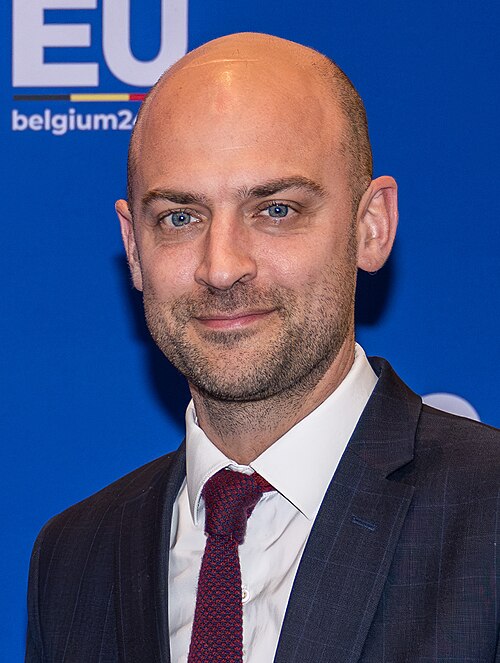 Jean-Noël Barrot
Transcription Whisper (large-v3), avec identification des locuteurs. À recouper avec la source d'origine.
Analyse automatique
Générée par IA — peut contenir des erreurs. Méthodologie
Chapitres
Répartition du ton (temps de parole politique)
Propositif 86 %Attaque 8 %Défensif 6 %
Questions et réponses
Taux de réponse directe : 100 % (directe = 1, partielle = 0,5, éludée = 0)
- 32:07OuverteRéponse directe
Plusieurs décennies plus tôt, Madeleine Albright parlait des États-Unis comme nation indispensable. Pensez-vous que l'Europe puisse être vue comme un continent indispensable ?
- 33:49RelanceRéponse directe
Comment évolueront les institutions européennes pour s'adapter au rythme d'un monde en crise ?
- 38:16OuverteRéponse directe
Comment gérer une Europe à géométrie variable tout en maintenant une identité forte ?
- 44:34RelanceRéponse directe
L'Europe n'utilise-t-elle pas tous les leviers de puissance dont elle dispose déjà ?
- 45:23OuverteRéponse directe
Pourquoi l'Europe n'utilise-t-elle pas tous les leviers disponibles en droit international et humanitaire ?
- 45:56OuverteRéponse directe
L'UE hésite à imposer de lourdes amendes aux géants du numérique par crainte des représailles américaines. Comment l'expliquer ?
Temps de parole
- Jean-Noël Barrot68 %
- ?14 %
- Présentateur7 %
- Présentateur 25 %
- Invité2 %
≈ 120,3 interruptions / 10 min (chevauchements et interjections détectés).
Modèle mistral-small-latest · prompt v1 · les citations sont vérifiées mot pour mot dans le transcript ; le taux de réponse directe est calculé à partir des verdicts question par question. Aucun label idéologique n'est produit.
Professeur d'International Relations.
C
'est un plaisir de vous accueillir à l'Institut de la Politique
mondiale. Nous
vivons pendant une période de profondeur géopolitique et instabilité.
La
guerre en Ukraine continue à refiner la sécurité européenne. La guerre en Iran
et
la
plus
grande instabilité dans le Médiaire portent des conséquences
globales. Et
la plus grande ordre d'ordre face la pression de la pression de la grande compétition
et
la fatigue institutionnelle.
Dans
ces
moments, la
diplomatie devient le travail pratique de naviguer l'incertitude,
de
maintenir la coopération, de éviter la crise de la croix.
Et
c'est pourquoi c'est important que nous créons un espace
où
des challenges comme lesquels que je disais peuvent être examinés
avec
rigueur
et
honnêtement.
C
'est le travail de ce que nous faisons
ici
à SIPA, et c'est le travail que nous faisons à l'Institut de la Politique
mondiale. Nous
convenons les politiques politiques, les scolaires, les pratiques et les étudiants pour discuter les questions les
plus
difficiles dans les affaires internationales avec candour et une commitment à un dialogue serious. Ce niveau de engagement, de nos étudiants, de nos étudiants, regardez-vous à
cette
salle, reflètes un sens d'urgence de
l'urgence
sur le monde qu'ils sont en train
d
'inherit
et
une determination pour aider à construire.
Nous
sommes très heureux d'obtenir aujourd'hui notre programme à ce moment-là,
et
d'avoir un certain nombre d'interests de cette conversation.
C
'est un commitment qui est également reflète dans notre partenariat
global,
including notre dual degree avec CNSPO. Est-ce qu
'on
a quelqu'un de CNSPO
aujourd
'hui? C'est-ce
qu'il y
a
quelqu'un de CNSPO aujourd'hui?
C
'est-ce qu
'il y a quelqu'un de transatlantique qui est très important aujourd'hui.
C
'est-ce qu'il
y a donc, c
'est
-ce qu
'il
y
a mon privilège et mon honneur de présenter Jean-Noël Baron. Le ministre Barraud apporte à ce rôle une combattance d'intérêt intellectuel,
d'expérience
politique,
d
'expérience politique, et de
leadership politique.
Avant d'assumer sa position actuelle
à
ce ministre, il s'est
-ce qu'il s
'est
-ce
qu'il
s'est-ce qu'il s'est-ce qu
'il s'est, on innovation, regulation of the digital economy, and Europe's technological competitiveness.
He
has been closely associated with efforts to strengthen European strategic autonomy, particularly in the areas of digital governance, industrial policy, and economic resilience.
He
was trained as an economist and having held several academic appointments, he also represents a generation of policymakers who move fluently between ideas and implementation.
In
his current role, he is at the centre of France's diplomatic effort on Ukraine, European security, transatlantic relations, and the evolving architecture of global governance.
More
broadly, he is known for advancing a vision of Europe that is both sovereign and engaged, and that is capable of acting independently when necessary while remaining deeply, deeply committed to alliances and multilateral cooperation.
That
tension
between,
sometimes between strategic autonomy and transatlantic partnership,
is
central to many of the choices facing Europe today, from increasing its defense budget to regulating AI and other emerging technologies.
After
Minister Baran speaks, he will be in conversations with our own, or his very own, Jean-Marie Guenma, where is Jean-Marie?
There
he is, whose leadership in international peace and security brings both experience and perspective to today's conversation.
He
is SIPA's Arnold Saltzman Professor of Practice in International and Public Affairs. He is the director of the Kent Global Leadership Program on Conflict Resolution,
and
he is director of SIPA International Conflict Resolution Specialization, and he is an IGP-affiliated faculty. Jean-Marie, thank you for guiding this important conversation.
And
my thank as well to the co-sponsor, to our co-sponsors, the Alliance Program,
the
European Institute, and the Saltzman Institute of War and Peace Studies. Minister Baran,
we
are honored to welcome you here to SIPA and to the Institute of Global Politics. Everyone, please join me in welcoming Minister Jean
-Noël
Baran.
Thank
you very much for this warm welcome. It's good to be back at Columbia. I'm saying back because 20 years ago as I was starting my PhD, I spent a summer of research on this beautiful campus.
I
was not within SIPA. I was at the business school. It was still a very wonderful summer.
What
I would like to discuss this afternoon
is
the role that we can expect Europe to play
in
the upcoming decades in the 21st century.
We're
now living through a moment of profound transformation, a moment when the world
is
not just changing, it is accelerating and also hardening.
And
many will tell that the trajectory is already written,
that
the 21st century will be defined by one single story, the rivalry between two superpowers, the incumbent superpower and the rising superpower, a rivalry that will inevitably lead to some form of confrontation,
and
that will force every nation and every one of us to pick sides.
And
the idea I would like to promote
in
front of you is that in this geopolitical equation, there is an unknown variable,
and
this unknown variable is Europe,
and
that Europe can dramatically change this geopolitical equation.
But
before I get there, let me say, as
I
was earlier at the United Nations, that force has never disappeared from international relations.
It
was never abolished, not by international law, not by global institutions. It was disciplined on a simple idea, one that French philosopher Blaise Pascal captured centuries ago. Justice without force is powerless, but force without justice is tyranny.
So
the challenge has always been the same. Make sure that what is strong is just and strengthen what is just. And throughout the 20th century, we've tried
to
strike this balance. After World War I, the League of Nations was a first attempt, an admirable one but incomplete
because
it asked states to renounce force without giving them the means to trust that others would do the same.
So
the balance was not struck.
After
World War II, we learn from those failures.
And
the United Nations were born, the Bretton Woods institutions.
Those
did not deny power. They organized it. They structured it. They made it predictable.
Let's
not
be
naive. The great powers did not embrace this system out of charity.
They
embraced it because stability, predictability, and order served their interests better than chaos.
They
also benefited from a privileged position with permanent seats at the UN Security Council
and
veto power.
Without
that arrangement,
no
lasting multilateral system
would
have helped.
And
no country benefited more from it than the leading power of the 20th century, the United States of America.
The
US reaped extraordinary, exorbitant dividends from multilateralism.
Security
dividends.
Through
UN peacekeeping missions,
the
US relied on others to help uphold global stability.
Through
the non-proliferation regime, it avoided the spiral of a nuclear arms race.
And
through NATO, it did more than guarantee the security of the North Atlantic. It also created a market, one that sustained the strength of the American defense industry.
Security
dividend. Monetary dividend.
Under
Bretton Woods, the dollar became the world's reserve currency.
That
meant something very simple.
The
US could finance their economy, but also their budget deficit,
more
cheaply than anyone else. Deficits became easier to sustain. Monetary dividend.
And
commercial dividend.
Through
the GATT, the General Agreement on Tariffs and Trade, and later,
thanks
to the WTO, American firms, especially in finance and digital services, were able to scale globally, with few barriers on their way.
Yet
things began to shift.
The
balance of power, carefully assembled over decades, started to loosen with the end of the Cold War.
The
collapse of the Soviet bloc was read in the West
as
final proof that the Western model had won.
A
world governed by law, organized by markets, anchored in democracy. The end of history
was
celebrated.
At
exactly the moment when, actually, history was starting again.
The
American hyper-power, confident and unchallenged, began to bend the very rules it had once defended.
And
for much of the world, this was not a moment of emancipation.
It
felt like supervision.
The
memory of colonial domination had not disappeared, nor the resentment of structural adjustment programs, nor the scars of unilateral interventions, and frustration gave way to something sharper, a desire for revenge.
Russia
saw NATO expansion as a form of aggression. China saw in liberal economics and human rights a system built without it. Across large parts of the world, multilateralism began to look less like a shared framework and more like a Western construction,
a
system designed by the West,
for
the West.
And
ignoring that perception does not make it disappear, just means that you no longer understand the world that you live in. Nowhere has this dynamic been more powerful than in China.
A
civilization that thinks in centuries.
A
civilization that sees itself not as a rising, but as returning from what it calls the century of humiliation, from the opium wars to imperial collapse.
And
the speed of that return has been staggering.
In
just four decades, China has transformed itself. Its share of global GDP rose from 2% to nearly 20%,
a
shift in the center of gravity of the world economy.
This
transformation lifted hundreds of millions out of poverty,
and
with prosperity came something else. Ambition.
To
reclaim a central role in the international order and to stand, eventually,
as
a peer, if not more, to the incumbent superpower, the United States.
And
China has been methodical. It has mobilized every level of power, deliberately, patiently, systematically.
Economic
power. Last year, China posted a trade surplus of over $1 trillion.
That's
not a coincidence. It is the result of a strategy.
An
aggressive industrial policy designed not just to grow, but to shape dependencies. Dependencies on rare earth, where China controls around 90% of refining. Dependencies on supply chains, on shipping, on ports and logistics networks, spanning more than 150 countries through the Belt and Road Initiative. Diplomatic power.
China
invests heavily in influence, bilaterally, regionally, and globally.
Through
the Shanghai Cooperation Organization, it anchors its neighborhood.
Through
BRICS, it challenges the diplomatic dominance of the G7, positioning itself as the voice of a global south, dissatisfied with the Western-led order.
And
today, BRICS outweighs the G7, both in population and economic weight.
Military
power.
The
People's Liberation Army
counts
over 2 million personnel,
the
largest in the world.
And
China also fills the world's biggest navy by the number of ships.
and
a missile arsenal designed with one purpose, keep American forces at a distance.
The
objective is clear, secure its region, deter intervention, and over time, reach strategic parity.
Put
it all together, and the picture is unmistakable, China is not only raising,
it
is positioning itself to lead,
to
become what it believes it has always been destined to be,
the
Middle Kingdom.
And
as China rises,
the
U.S. faces a familiar and dangerous trap.
What
some have called the Thucydides Trap, described over 2,000 years ago.
The
tension between a dominant power and a rising one.
A
tension that often leads to confrontation.
Look
back to
five
centuries before Christ. Sparta
faced
it when Athens rose,
and
it chose war to prevent Athens from reaching dominance.
The
Peloponnesian War.
30
years later, both cities, Sparta and Athens,
were
exhausted by war,
and
then came a third actor, Macedonia,
which
went on to conquer the Greek world. Macedonia did not win by chance.
It
won because while others were fighting or confronting,
it
prepared,
it
reformed. Militarily, it forged a professional army, developed new weapons, and perfected the phalanx. Politically, it centralized authority, and built a new disciplined elite. Financially, it created a stable currency and mobilized its resources for long-term ambitions.
While
others were exhausting themselves in endless wars, Macedonia was positioning itself
as
a third actor.
And
you might start thinking where I'm trying to go there.
Today,
in Washington, China is indeed seen as the defining geopolitical challenge of our time.
And
the response has been building through time. Tariffs targeting hundreds of billions of dollars of Chinese goods.
The
banning of TikTok. FISA restrictions on Chinese students and researchers working in sensitive fields.
The
blacklisting of Chinese firms cut off from U.S. infrastructure and public procurement.
Export
controls on microprocessors, semiconductors, and advanced ships.
A
massive reinforcement of U.S. military presence in the Pacific.
An
attempt and rapprochement with Russia, seeking to pull Moscow away from Beijing in a reversal of Nixon's strategy.
A
military intervention in Latin America aimed at reshaping control over an oil-producing country central to China's supply. Territorial claims over a European territory under NATO protection justified as a way to prevent Chinese access
to
the North Atlantic.
These
are not isolated moves. They form a pattern, a strategy of containment.
And
so we find ourselves far from the spirit of 1945, far from the UN Charter. Instead,
we
are entering in a world of competing orders. China advancing its own vision of global governance.
The
United States proposing new structures, such as the Board of Peace.
Where
does this lead?
At
best, to a fragmented world, split into spheres of influence. At worst, to direct confrontation between two permanent members of the Security Council, to equip nations.
So
the question becomes,
is
this inevitable?
Are
we condemned to choose, to align, or to submit?
I
don't believe we are, because of Macedonia.
Because
in this equation that is complex, unstable, and still unfolding,
there
is one variable that can change the outcome.
One
variable that is not yet fully played, and that variable
is
Europe. Yes, Europe is the X factor in today's geopolitical equation.
Why? Well,
because this is where resistance to the brutalization of the world is indeed taking shape.
Because
from Southeast Asia to Latin America, across Africa, free people, and that are willing to remain so, are watching Europe, waiting for it to step up,
and
waiting for it to lead.
In
a world increasingly forced to choose between submission and confrontation, Europe is expected, where it has always been strongest,
in
the ability to chart a third path,
a
demanding path anchored in national sovereignty and in respect for international law. More and more states attached to their independence are refusing the logic of blocks.
They
are looking for balance.
They
are looking for space.
They
are looking for an alternative. And today, that alternative depends on one thing, a stronger Europe.
That
is why Europe is, in my view, the X factor.
Some
would rather see Europe as a political organization weakened. Others would prefer it divided. Many
would
be more comfortable if it simply disappeared from the equation.
On
the Chinese side, the strategy is subtle.
Beijing
is working to bypass the Europe as a union, engaging capitals one by one, building bilateral ties,
while
skirting the EU institutions themselves.
On
the American side, the challenge is more explicit.
in
the National Security Strategy published in December 2025,
Europe
is portrayed as weakened, undermined by migration, constrained in its freedoms, repressive towards political opposition.
A
continent condemned to civilizational erasure,
quote,
unquote.
The
logic is easy to see.
A
fragmented Europe is easier to dominate. A divided Europe is easier to align.
A
dependent Europe becomes a secondary player.
But
no, Europe is not on the brink
of
an eraser. European civilization is not fragile. It is a civilization of the mind,
forged
over more than two millennia, through conflict and reconciliation, through failure and renewal.
A
civilization that has known the worst and produced the best. Stefan Zweig called Europe a forge of ideas. And he was right. From the encounter of Latin, Germanic, Anglo-Saxon and Slavic worlds emerge ideas that reshaped history.
And
it is precisely this capacity to absorb, to transform and to create that gives Europe its civilizational depth.
Europe
was here before, and it will be here long after.
This
is a civilization that has faced division again and again,
and
each time found a way to rise above it.
Europe
has given so much to the world. It has shaped ideas, sparked revolutions, and defined what we mean by freedom and democracy.
This
continent gave birth to one of the most ambitious political constructions in history,
the
European Union.
born
on May 9, 1950 in Paris at the Foreign Affairs Ministry.
Eight
decades of peace, eight decades of democracy, eight decades of prosperity.
Look
at the world today. Ten countries are candidates to join the European Union.
What
other political project inspires such attraction?
And
I'm saying ten,
but
that does not include Iceland or even Canada.
in
Tbilisi in Georgia,
on
the Maidan in 2014, people stood together, waved the European flag and singing the European anthem as a symbol of hope.
What
other political ideal inspires that kind of passion?
Look
at the outcomes.
people
live more freely in Europe.
They
live longer and in better health.
Life
expectancy is higher, about four years longer than in the US or China. Infant mortality is lower, often half as low. Inequality is lower as well.
This
is a model
worth
defending.
When
great powers compete without restraints,
bear
in mind that they also weaken themselves and they create space for others.
This
is the moment that we are going to live.
And
Europe is stepping up.
It
is stepping up into the space
that
is made available and seizing the opportunity.
Since
2017 and the Sorbonne speech delivered by President Macron calling for European strategic autonomy, we have moved
on
security, prosperity and democracy,
three
values at the heart of Europe's priorities.
On
security,
for
years, speaking of European defense was a taboo.
We
were told it would weaken NATO. Today, that debate is behind us. European defense is becoming a reality.
And
this shift is visible in concrete terms.
New
strategic frameworks,
stronger
coordination, greater role for the European Commission,
the
reactivation of the European defense agency, and new European funding instruments with a clear and assumed European preference.
And
sure,
Ukraine
has been a turning point.
Some
believe that Europe could not sustain Ukraine without the United States, that peace
would
be decided elsewhere.
Reality
proved otherwise.
And
as we are speaking, Ukraine is gaining ground after having survived one of the toughest winters in recent history,
while
Russia is failing.
Failing
militarily,
with
a loss of one million casualties since the beginning of this war,
and
more than 1,000 casualties per day on the front line. Failing economically as well,
with
an economy that is turning into a train rake.
And
we are preparing for peace.
We
launched the Coalition of the Willing,
and
we built something new. Today, Europeans, together with partners such as Norway, the UK and Canada, are delivering the bulk of support to Ukraine and preparing the security guarantees for the future.
We
support American diplomatic efforts,
but
we ensure that our interests are not overlooked,
because
peace cannot mean capitulation, and it can come at the expense of European security. Summary, Europe is now taking responsibility for its security.
On
prosperity,
European
economy faces a dual pressure. Chinese competition and American tariffs.
Even
countries that once ran suplices with China
are
now running deficits.
Even
Germany,
along
the industrial benchmark,
has
lost tens of thousands of jobs to China.
The
response must be clear,
and
now it's becoming to be.
First,
shelter our market from unfair competition.
Europe
is not just a marketplace.
It
is an economic power, and it must act like one.
That
shift is underway,
and
from steel to clean tech, from chemicals to automotive, Europe is deploying trade defense instruments. Tariffs on heavily subsidized Chinese electric vehicles are one example. European preference is no longer a concept. It is emerging as a policy.
Second,
strengthen competitiveness.
A
market of 450 million people must become a true economic force.
that
means less fragmentation, simpler rules, a deeper single market, capital markets union, integrated energy systems.
All
these reforms are on the table, and we are working to turn them into reality.
Third,
invest.
Europe
must invest more and faster in strategic technologies, such as AI, quantum, space, and green tech.
We
have the capacity. Europe holds the largest pool of savings in the world,
yet
too much of it flows abroad. This is not sustainable, and it is beginning to change. Fourth, diversify.
Europe
is expanding its partnership
recently
with India to open new markets and reduce dependencies,
because
resilience comes from choice,
and
Europe has what investors are looking for, a stable currency, a predictable regulatory environment, world-class infrastructure, a highly skilled workforce.
In
a world of uncertainty, Europe offers something rare,
trust.
Security, prosperity,
democracy. Europe's
independence is about protecting freedoms.
The
freedom to decide, to speak out,
to
vote, to move,
to
pray.
Our
democracy and the rule of law are the guarantors of those freedoms.
This
is why we have done so much to protect our democratic space. Defending academic freedom, protecting the independence of science, preserving an open but regulated information space.
A
space where ideas circulate freely, but where choices are not dictated by opaque algorithms.
This
is the purpose of the regulation that were adopted recently.
The
rise in information manipulation and disinformation is dividing our societies and eroding democracy.
This
is a major threat,
and
that is why we're building a European democratic shield.
We'll
set up a European center for democratic resilience that will bring together all the expertise and capacity across member states and neighboring countries to fight disinformation and protect our elections.
So
just like Macedonia during the Peloponnesian War, Europe is building its muscles.
Security,
prosperity,
and
democracy.
This
is how Europe is preparing itself for a world of rising rivalry between two blocks.
not
by choosing sides,
but
by building strength and power on its own terms.
And
in doing so, Europe is not just serving itself.
It
is actually serving the world.
By
keeping open,
or
let's say by opening and keeping open,
not
a straight,
but
a third path,
a
path that refuses both submission and confrontation,
Europe
is indeed serving the world.
Because
Europe is standing up for freedom and sovereignty wherever it is threatened, in an age of polarization, Europe can be a buffer, a stabilizing force for many countries that rely on it,
a
force that absorbs shocks and rises above them,
a
force that keeps the system from breaking apart.
Europe
is standing up for the vast majority of the people.
So
if you're asked today
what
defines the global geopolitical landscape,
one
thing is certain, Europe
is
rising. So friends, watch Europe, watch it closely.
If
you're looking for power, look at Europe.
If
you're looking for stability, look at Europe.
If
you're looking for opportunity,
look
at Europe. Because Europe is growing into a superpower that is attractive, democratic, and predictable.
A
place where prosperity is shared and where the pursuit of happiness is a reality.
So
friends, watch Europe,
watch
it closely,
because
it will play a very significant role
in
the geopolitical equation of the decades, perhaps the century to come. Thank you for your attention.
Minister, several
decades ago, Madeleine Albright talked about the United States as the indispensable nation.
And
I think you just gave us
a
vision of an indispensable continent,
Europe. Without
Europe,
we
will have a world of confrontation at worst, fragmentation at best, as you described.
And
I think many in this room would
agree
that indeed we don't want that future. And as you said, many countries want to embrace the European vision
of
a world governed by cooperation and multilateralism rather than the pure rule of force.
At
the same time,
I
have to be candid with you,
I
think a number of people wonder whether Europe, the European people are going in that direction.
They
see the rise of nationalism.
They
see institutions that are slow to make decisions. You talked about the acceleration of crisis.
And
so they see a tension between the slowness of institutions that usually leads to good decision, but those decisions are not necessarily at the pace needed by the present world. So you have been a very, I mean, you are a very experienced practitioner of European institutions. I think any foreign minister, and you are the Minister of Europe and Foreign Affairs, spends a lot of time dealing with European colleagues. How do you think those institutions are going to evolve? How can
you
make them more attuned to the pace of a world in crisis?
Well,
thank you for this question. It is key.
To
me,
the
issue is not one of governance architecture.
Other
superpowers have been led in a collective manner.
Think
of Venedia, Venise,
that
were run by the Doge, by a collective group of people,
that
were able to make,
you
know, enlightened decisions and to maintain their domination for decades and centuries.
So
the issue is not the governance structure.
I'm
not sure the issue is with the rulemaking process.
We
feel it's too slow. It's often too slow.
But
it can also be super quick. Recall what happened
during
the COVID crisis, where in a few weeks only, the heads of states and governments of the European Union
were
able to agree on a historic common borrowing scheme
that
prevented the European economy to collapse.
And
just a few days after Vladimir Putin launched its war of aggression against Ukraine,
again,
the heads of states and government were able very quickly
to
adopt historic sanctions against Russia.
So
if it's not about the governance structure,
if
it's not about the rulemaking process,
what's
the problem?
Well,
to me the problem is the will and the courage.
It
is the ability of the European people to face reality
and
to make the right choices.
Choices
that call
decisions that
can sometimes be painful in order to preserve our model
and
to open this third path.
And
for that you need to fight against inertia
because
Europe,
including
the EU, was not created by Robert Schumann and Coran Adenauer
to
become a third path.
It
was created to diffuse tensions on the European continent by creating cooperation mechanisms across rivals so that rivalry and war give way to competition and cooperation.
And
so now the question is whether and how
much
we want to move from this political organization that has guaranteed peace and prosperity to something stronger and more independent, which is
what
we have been calling for again and again, what President Macron has coined strategic autonomy,
which
is making progress in the European minds, but which is not entirely translated into decisions as we speak.
But
it's really only about willingness to act in the face of reality.
So
opening the eyes of Europeans on the challenges,
on
the fact that their independence is at stake
and
that Europe has a unique and historical role to play in this world dominated by the rivalry of the two superpowers.
You
said that there are ten candidates
to
the European Union, which is really an illustration of the, as you said, of the validity
of
the model.
But
at the same time, it is a kind of challenge because
at
a time when people are so focused on identity, not having a clear sense of where Europe ends, that uncertainty, you can see it in campaigns against Europe, it is an issue. On Euronotes, there is a very clever way of – you don't know really where Europe ends on a banknote, on a European banknote. But we see that issue coming even just recently, the discussion on Ukraine. France has made a clear proposal on Ukraine and how Ukraine could join the European Union and we know all the challenges. Ukraine is a big agricultural power. It's also now a big in the defence industry power, but it does raise questions for the internal functioning of Europe. How do you see this management of a Europe that,
in
a way, will inevitably have kind of variable geometry and yet have a strong European identity?
The
people of Europe are feeling the pressure
by
the superpowers and they are not happy about it.
They
feel that
they
are being deprived of their ability to decide for themselves, to build their own destiny and to be free.
They
are not happy about the situation.
And
they are actually craving for more sovereignty.
And a
large number of them understand that some dimensions of their sovereignty
can
only be achieved at European scale.
And
that's why they are expecting
their
leaders, leaders
of
their countries but also leaders of European institutions,
to
stand up and to cater
to
their request for more sovereignty.
And
this is why I agree with what you say.
We
have a
common
currency, at least some countries of the European Union.
We
need to fix and to make more credible certain of the attributes of sovereignty that are now perceived as being,
you
know, half-baked by European citizens.
And
this includes the border.
The
border
is
felt by European citizens as being violated all the time.
With
products coming onto the single market illegally or not respecting the single market norms. Illegal immigration coming into the European territory without being credibly filtered or controlled at the border. Fortunately, we've started to take actions
to
make sure that the border is actually a border.
And
in particular, beginning in summer 26, there will be an actual, a true digital border
in
Europe, which is a result of the Pact on Asylum and Migration that was adopted in 2024,
with
actual controls and actual filterings.
But
it's not only the circulation of people, it's also the circulation of goods that is raising a lot of anger at the people level. And so, yes, I think that in the moment that we are living through, again, currency is already treated. The border is something that needs to be consolidated.
And
then defense
is
another attribute of sovereignty
where
people in Europe are expecting tangible acts and results.
I
think that the idea, which France does not support, of a European army has never been so popular as it is now in Europe.
Because
it is an attribute of sovereignty.
Now, what
will happen
if
in the face of the pressure that we are feeling more and more, that we are feeling the pressure of coercion, of tariffs, of everything else,
what
will happen if
we,
the leaders of Europe, do not cater
to
the aspiration of the European people for more sovereignty? What will happen?
Well,
they will seek
sovereignty
elsewhere.
And
they will go to those who have been doing that forever,
the
nationalist political forces.
And
that's the trap of history, right?
You're
under the pressure of superpowers.
You
have an open path towards more European sovereignty. But the superpowers do not even have to exert the pressure. You inflict
the
pressure on yourself by appointing nationalist leaders that are going to dismantle
the
solidarity links that we have created to be stronger and more sovereign, be it the EU or NATO. You see what I mean?
Those
who don't like
the
EU, as I was saying earlier, if nationalist parties or forces
get
traction in Europe, they will finish the job. Neither China nor the US have to do the job. They will finish the job instead of them.
And
so there is indeed an urgency to build those attributes of sovereignty. Is the EU,
the
27 and perhaps
soon
larger circle, is this circle
the
only one through which we can provide sovereignty to the people of Europe? No. Currency is not dealt at 27. Defense could be dealt in smaller circles. Border is dealt at a wider circle because Schengen is wider than the EU.
And
so we need to be pragmatic.
We
need to basically remain faithful to the single principle based on which the EU was founded, subsidiarity.
Whatever
is your purpose, make sure that you do it at the right level
where
power and responsibilities can be exercised in the most effective manner.
Yes,
but
if
I want to push you, I would say that
in
Europe, many people believe that Europe is not fully using the levers of power it already has. My colleague at Columbia, Anu Bradford, the Columbia Law School, has written about the Brussels effect, the Europe as a normative power, which indeed it is.
But
in difficult situations,
there
are questions.
Let's
see peace and security. There have been
clear
violations of basic, not norms, but really articles of the United Nations Charter. In a country that is close to the heart of all French people, Lebanon, we see the issue really now. And yet there are declarations, significant declarations, but
there
is a sense that Europe,
when
it comes to international law and international humanitarian law, is not always using all the levers that it could use. And that damages its image. When I live in New York, I see the United Nations, it damages its image. That's one issue. And when we come to tech,
we
see how, yes, the European Union has issued a number of strong regulations, but it hesitates to impose big fines on tech giants because it is afraid of the repercussions with the U.S. tariffs. And so we see a Europe that is potentially powerful, but that is
hesitating. Yes, that hesitates to speak freely because of two reasons, I think.
One
is that it remains too dependent on others. And so when you're dependent
for
your
day
-to-day subsistence or for your security,
then
you think twice before you make strong statements about something that happens on the other side of the planet.
This
is perhaps why France
is
sometimes seen as speaking a little bit more freely than other European countries, because we've made choice after Suez
to
be more independent on our energy supplies and on our security than other European countries.
So
what's the response to this first reason why we sometimes do not speak or act
as
we should in foreign policy matters? Well, it's to reduce our dependencies. Let's get rid of them.
Let's get rid of them
in order to speak freely
and
to make our own geopolitical choices and decisions.
What's
the other reason?
We
had this discussion with our ambassador on the way here in Colombia.
There
is something about inertia
and
about courage.
Again,
the EU was founded
thanks
to the US, with the help and the support of the US,
by
countries that have relied significantly on the US to grow back
after
or on the ashes of the Second World War.
And
this has created in the administrative ethos of Europe a strong inertia.
And
it is hard to change those deeply rooted habits.
People
are asking themselves,
if
I really listen to the French and I'm going to
take
these reckless decisions, what's going to happen to me?
Am
I not going to lose everything?
Am
I not going to risk my comfort, my safety, my prosperity?
So without
being arrogant,
because
I didn't make these choices, the ones that General de Gaulle made
decades
ago, but I inherit from those choices. And the very least I can do is explain those choices to my European friends and colleagues
and
tell them,
get
rid of your dependencies. You will speak freely and you will be respected for that and your impact will increase.
And do
not
overestimate
the cost associated with changing habits,
with
living inertia. Yes, it can be a little bit, you know, it can hurt a little bit,
but
it can also bring a lot of good to you and to your people. And so you need to have the courage to take this kind of risk.
But
all of this will not solve our issues with international law and the international humanitarian law.
And
there are constant violations now. Europe has contributed to build this architecture. Europe should take its responsibility to safeguard it.
But
I think we have an organization, an institution that is now
being
paralyzed and that needs
strong
reform. This is something I tried to do while I was in New York earlier today. In particular to push, sorry to advertise what we're currently doing, but to push one initiative
that
I think is very important to restore the effectiveness of the Security Council in terms of peace and security,
which
is to restrain the veto power of permanent members of Security Council in cases of mass atrocities. This is an idea that France and Mexico
have
carried together for ten years
that
they got from the Syrian theater, where hundreds of thousands of people were being slaughtered and where
the
Security Council was blocked by
Russian
veto.
And
so we're trying to promote this idea, push it as far as possible and hopefully bring it to the General Assembly in the months to come.
I
don't know if I have time for one last question
about
China. You started with China, the two-city traps. How should Europe handle China? I mean President Macron I think in Athens said Europe has now three adversaries, President Putin, President Trump, Chairman Xi Jinping. That's a lot. The Europeans need to find some tactical accommodation with each of the three. And since we don't have enough time to deal with all three, I would ask you about China.
Yeah. A
lot of adversaries, but you know Asterix, we have a magic potion, so
we're
not afraid of anyone. The relation of France with China is deep, it's ancient, and it's very dense.
And
the way we approach China on some of the issues
that
raise concerns in France and Europe
is
based on three Ds.
The
first D is de-risk,
meaning
reduce our dependencies with respect to China. Rare Earth is one of them.
There
are other dependencies that require from ourselves to either be able to produce on European soil or diversify our partnerships. Otherwise, the relationship is unbalanced when you're too dependent on your partner. Second, dialogue.
And
tell China that
one
way or another,
if
the tsunami of Chinese industrial products
keeps
destroying European industry, someone will stand up
and
apply Trump-like tariffs on China.
So
unless we are able
to
restore some kind of balance, and this you do through dialogue,
then
at some point
the
confrontation, the trade war, whatever you want to call it, is inevitable.
If
it's not the pro-European forces that apply this kind of remedies, it will be populist or nationalist powers that will do it. They will just close the borders,
because
it will not be sustainable.
That's
the second D, dialogue.
And
the third D is deter.
Both
China and the US,
and
this is also one thing I keep mentioning to my European friends and colleagues, have a vital need
to
access the European market. European market is the largest, especially if you think about the great Europe, beyond the European Union, it is the largest of the world.
It
is very difficult for China to sustain its model
without being
able to address the European market.
And
on the other side,
bear
in mind that
a
quarter of the revenues
of
American big tech,
and
probably half of their profits are done in Europe.
If
you cut off Europe
from
the profit and loss account
of
American big tech, it's a big, big cut.
And
same with spending. Europeans invest three trillion more in the US than Americans invest in Europe. So America has a vital need of European savings.
And
we have now very powerful instruments
that
have never been really used so far for fear of
confrontation
with China or with the US.
But
we have a very attractive market, a vital market for both superpowers. And we have instruments that allow us to cut them off, this market, should they affect, of course, vital interest for Europe.
And
I would sort of, I would not use the bazooka at the first occasion. But I'm saying, if it's about the survival of the European economy, if it's about the protection of electoral processes and democracy, if it's about protecting European borders or the integrity of European territory, then European has very powerful levers to overturn the decision that can be made by one of the
two. Well,
thank you very much. I see in the audience, I'm sure there are going to be many questions. So I will give priority to the students. I'll take two or three questions at a time. Please identify yourself so I see the gentleman on the left.
There's
a microphone coming.
Bonjour, Monsieur le Ministre. Je m'appelle Alexandre Serrat. My question has to do with European defense and its leadership.
So
if France always doubted the reliability of the United States and provided extended deterrence or leading Europe's defense,
on
what basis should all the European countries place greater trust in France to fulfill that role?
In
other words, if the United States is today deemed unreliable, what actually makes France any more trustworthy as Europe's main security guarantor?
OK,
maybe a couple more questions. Yes?
Microphone.
Can I ask in French?
OK.
Bonjour, Monsieur le Ministre. Vous parlez beaucoup de l'Europe comme variable à haut potentiel dans l'équation géopolitique et le jeu des puissances
et
de
l'importance de... Oh, in English? The Minister
will understand French, but maybe not
the whole audience. Oh, sorry, because
I prefer it in French, so I was more prepared to say it in French. But let me know if I need to say it in English. You speak a lot about how Europe is to be a superpower tomorrow and that it's important to face the threats that the United States or China or Russia can represent. France, I was wondering if this idea of a Europe that is able to weigh and may be capable of resolving the crisis of multilateralism is somehow based on the idea of, like, an equilibrium piece, , like, hérité du congrès de Vienne, and that if it's possible to sustain that idea despite the failures of the Security Council during the 21st century. Thank you.
OK. And
the third question, and then we...
Hi.
Bonjour, Monsieur le Ministre. Thank you for joining us today. I was wondering, so regarding the tech policy, most of the developers you talk to are, in fact, themselves overwhelmed by the pace of AI. And so they make a strong argument that they think that the policy will not be able to catch up to the pace of AI development. So I was wondering what you would answer to them.
In
Europe, you mean?
Yeah.
From the European policy
standpoint. OK.
So first on nuclear deterrence, in Norway is the recent announcement by President Macron to strengthen our deterrence posture and to materialize the European dimension of our vital interest, which is called forward deterrence. In Norway is all of this meant to substitute to the American nuclear deterrence in Europe.
But
that being said,
your
question was broader than that,
and
I think,
you
know, is an important one.
What's
the right response to the sort of impredictability of, well, impredictability of
US
strategy and also US
willingness
expressed,
that
has been expressed for a long time now, to review
the
level of their commitment within NATO? What's the right response?
Well, you
have two schools. One is to cry
and
to let yourself be seized by despair.
And
the other one is enthusiasm and saying that the time has come for Europeans to develop their own vision and capacity within NATO.
And
I think this is what we should do
and
take seriously what the US have told us for a long time now. Please pick up
a
bigger share of the so-called burden. And this is what we have decided to do, which I think is a good thing, including because it makes us
gradually
less dependent, so we can speak freely,
so
we can have more balanced relationships with the other powers of this world. So I think it's great. The only thing is, of course, that it means big money.
And
so it requires choices, decisions, breaking habits, breaking inertia, etc., etc.
You
spoke about the Congrès de Vienne, Vienna Congress, and yes, it's more or less the idea. Open up a third path,
and
you will see that many countries in the world will join your coalition.
In
other terms, virtually all countries in the world are hoping for something else than a
sort
of global scale
rivalry
with the obligation to pick sides.
And they
are right to fear this from happening, because
the
race to the domination will take technological, military, commercial forms,
but
it will also take the form of a race to the alliance.
Who's
my friend? Who can I rely on? The more friends and allies I have, the fewer he has, or the fewer the rival will have.
And
when you capture Maduro, and then when you kill Khamenei after Bashar al-Assad has fallen, you're also, in some sense, trying to weaken your
rival by
removing some of its own allies and so on and so
forth. And
so virtually all countries of the world would like to have a safe place, a safe path, where they don't have to pick sides. But no one can, no other, I think, no other block than Europe can actually open such a path.
Not
that we are brighter. We're not. But we're just a more advanced coalition of countries where, because of history, we're wealthier than the other blocks. And we have this long history of war and suffering, and so on and so forth, that led us to be first contributors to the foundation of the UN and international law. And so we have a lot to offer in terms of international architecture.
Right
now,
speak
to leading nations in Asia or Africa or Latin America. They want us to stand up, but they don't see us
right
now as an alternative. Because they also have doubts as to whether we're going to be able to break inertia, to chain our habits, and to turn ourselves into a democratic superpower that is predictable and respectful of international law, sovereignty, and so on and so forth.
And
that's why I'm here, road showing that, yes, Europe is on the verge of becoming this democratic superpower. And this is what President Macron has been doing also in his various travels, including recently in Japan and South Korea. There is an interest for something else than having to pick sides
or
try to survive in between the two superpowers.
And
the last question was about digital. Yeah.
Clearly,
our dependencies
are
very alarming in terms of security,
even
though France is a bit of an exception, in terms of space and in terms of digital, in my view.
This
is why,
to
be really honest, because I was in charge of digital a few years ago, this is why we've been, and people have had a hard time reading us, but we've been super hard
on
the regulation of incumbent waves of digital technology, such as social networks, marketplaces,
the
revolution of 10 years ago that we just did not see coming. So now we've taken one of the most ambitious set of regulations to impose certain rules to the providers of these platforms. And we're hoping that
the
Commission can enforce these rules, because otherwise, what's the point of having a Commission, you know?
And
then, when came generative AI,
we
took the exact opposite stance. Why?
We
said
to
our European colleagues, do not regulate generative AI. And they were like, but I don't understand. You know, you exhausted us with regulations on social network, and now you don't want to regulate generative AI. What happened?
We
said, as long as we have a chance to forge our own generative AI, then we had better
give
as much possible space to innovation
than
regulating it upfront. Because the one that forges the technology always has more power on the technology the way it is used than the one that regulates
it. And
I think
we
perhaps saved
the
ability of Europe to have not
the
leading, you know, not the top one or two
players
in generative AI. But I think we do have
now, with
Mistral AI and its ecosystem,
we
have a generative AI technology
that
would
be
sufficient should we face massive restrictions from access to AI technologies coming from abroad. I'm not saying we would have the top of the pop technology, but we would have enough. And so we've been able, by perhaps for the first time regulating a little bit more smartly than before, or an emerging technology to give enough space and room for our own players to reach a stage where they are not completely outplaced.
Of
course, we need to go further. And this is something that I hope to see emerge in the French-German framework, because I think these are two
very
significant driving forces when they get together and they agree on principles. So we're in the process of working together to
make
sure we have the right European champions in AI and quantum,
but
that we also have an environment where we see more and more innovation in this field.
Yes,
another round of questions. So the lady in the back.
Thank you so much, Minister, for your question. So my question is like in your talk, you mentioned a lot of things about savings and the foreign aid. So my question is like you mentioned a lot of savings are going abroad and overseas, and it's not sustainable, and it's beginning to change. But how does that change translate into your FDI, the foreign development assistance? And also how do you strike the balance between international development, the expectations, and the less outgoing savings and aid? Thank you so much.
Okay.
Yes.
Thank
you so much. My question is about the far right in France. You mentioned that we are in danger if the tsunami of goods from China come over that we could have our own Trump in Europe. And now in France, the polls are pointing towards a very bad direction. What do you see is the main reason for this? What are you planning to do about this so that next year we can still welcome you here?
Okay. And the lady in the back there.
Thank
you so much. Bonjour, Monsieur le Ministre. My question is actually pretty related to the one I was just asked. You mentioned earlier stability, algorithms, spread of information. So how do you see the evolution of terrorist threats in Europe over the next decade, particularly with increasing food of population and digital radicalization, sorry? And to what extent do you think that this might undermine Europe at the international stage?
Good
point.
So
on the first one, the only thing I was saying is that
a
lot of our savings are going abroad and we have an issue with our capital markets. Capital markets are necessary for an economy to grow strong. And again, going back to Macedonia, Philippe II, what he did is basically forge a currency, spread the currency around him, and so suddenly he had a financial system, basically.
And
we do not have a financial system that is robust enough and markets that are liquid enough to support the growth of our economy. And it's also a vicious cycle because when your market is not liquid enough, then your own savings tend to go elsewhere to find liquidity and yield and returns and so on and so forth. So there is a lot to be done
to
build those capital markets. Then in terms of foreign aid, I don't think it's a directly connected point, but I just want to recall that by far the EU is the largest development aid provider around the world.
Sometimes
we tend to forget this. Sometimes we also tend to say that Europeans are being chased from everywhere, including from Africa. But this is just fake news and propaganda on social networks.
I
realize that looking at the numbers.
And
when you look at foreign direct investments
in
Africa, when you look at trade relationships,
when
you look at the number of students
from
Africa that are going to the European Union or US, China, Russia,
you
see that Europeans' contribution
to
the development of the African continent is not 10, not 20, not 50 times larger. It's like 200 times larger.
Anyway, so
these I see as two separate questions but two important
ones. The
far right.
So I
actually have another version of this speech
where
I say
the
unknown variable of the geopolitical equation is Europe.
And
I say
the
unknown variable within the unknown variable is France. And indeed, depending on what choices will be made by the French people next year,
a
lot will be determined in Europe. Just like I would say exactly the same thing if Germany was facing this kind of elections.
So
why is the far right so high?
Well,
to me, for exactly the same reason as President Trump won the election here.
Because
people feel that they are losing grip on their life and on their destiny.
And
that
the
responsibilities are diffused, that people take decisions without
reporting
or giving accounts on these decisions.
And
people that, well, they are losing control.
And
I think what President Trump has promised,
that
I think was very powerful, is to take back control over
what
he framed as the elite that in Washington DC or in Ivy League universities were exerting power instead of the American people.
Is
the American people more powerful than it was before the elections?
Not
necessarily. But there is this feeling,
because
power was centralized more than it was before, that the feeling that you live
through
a proxy, some kind of reappropriation of power and your own life.
And
you feel that some things are changing. You're not the one really deciding, but you're having this feeling through the proxy that you have elected.
And
so far right in Europe is rising, in my view, for this exact reason. The fact that people feel dispossessed and they feel that the state is powerless.
And
to me, the only way to address, to cater to this need or to this feeling
is
to address it, not to turn a blind eye on it.
But
rather than to offer centralized solutions where power is going to be concentrated in the hands of a few,
rather
to offer the opposite,
a
massive redistribution of power.
To
the people and to the society as a whole. And if you're able to put forward something like that
in
a credible way,
then
people might be interested. Because they will understand that you are catering to their feelings and their expectations, and that you're proposing a way out
of
what they feel is attrition
of
the elite, with respect to the promise that
people
can write their own history.
And
then on terrorism,
the
threat is still there.
And
Europe has
countries
across Europe and France have taken measures to contain this risk. It is true that we're seeing phenomena of radicalization
and sort
of
triggers coming
from exposition to social networks.
And
so
the
answer to the very strong polarization that we're seeing of European societies, and that is, in my view, inconsistent with well-functioning democracy, is first to
forbid
or to restrain exposure of youngsters to social networks. And then to really impose very strong rules on social networks. Because what we've done is we've basically allowed our public space
to
be moved onto platforms,
which
rules are determined by Chinese or American billionaires that have no interest whatsoever in designing democratic public space.
So
one way or another, this is going to weaken democracy. Democracy works because people have
the
same
one
-man-one-vote rule.
But
it also works, and this is a necessary condition, when citizens are enlightened, when they understand the choices that they have to make. So unless we take back control of our public space, then there will be democratic backsliding,
inevitably,
including in Europe.
Yes, the gentleman.
Thank you. Bonjour,
Monsieur le Ministre. So to go back to the first questions about speed and inertia. So when you look at the U.S., they won't hesitate to use tariffs, coercive military force, energy,
a
lot of different things. Don't you think there's an issue with Europe being more on the offense and also coordinating all these tools? Hi, Mr. Minister. My name is Sardar coming from Uzbekistan and the global leadership program. So my question is regarding your leadership skills. I know that France is doing a really great job on public diplomacy right now.
So
France was one of the first who released the tanker of CME ACGM from Hormuz Street. And from the backyard, European war with Russia-Ukraine. So I would like just to ask about your leadership skills, how you manage all of that conflicts.
These are not my leadership skills. The leadership of the diplomats that are with me in my delegation.
And
one last question. Yes, on the right.
I
will go back to your point.
Bonjour, Monsieur le Ministre. You mentioned President Macron's visit to Japan and South Korea recently. I was wondering if you had any partnerships that you found especially vital, whether it be in Africa or in other regions of the world, in order to shift the focus away from the strategic competition between China and the U.S.?
Okay.
I think that's, we don't have time probably for another question. So, Minister.
The
first question was about... Yes. How do
we
mean?
Yes.
It's very easy.
Because,
you know, on tariffs, you cannot even blame, you know, the 27 blah, blah, blah. It's up to the European Commission to decide.
It
can be very quick, actually.
And
whether you take the decision by yourself
or,
sorry, you take a tariff decision
or
you take a defensive decision.
We have
adopted in 2023
a
policy
instrument
that is called the anti-coercion instrument
that
gives the ability to the European Commission to turn off
access
to the single market
for
companies, goods, services coming from a country that is exerting coercion on the EU or some of its member states. So,
it's
very easy.
But
again, it's part of this sort of inertia
where
people still think that, you know, WTO
was
basically the culmination of history and that we've moved away from WTO rules, but that we're going to go back to them.
And
there's difficulty to project yourself in a world
where
you don't go back to WTO
for
a long, long time. And so you still hope that by acting gently and by avoiding escalation,
you're
going to elicit
benevolence by
the other party,
which
I think is wrong in a geo-economical framework.
I
think you need to establish deterrence,
and
to establish deterrence at some point you need to show that deterrence works, right?
So
that you don't have to do it ever again and no one will come and, you know,
bite
you. Because they know that a long time ago someone came
and
they bit Europe and Europe responded and, you know, it was bloody. So
it
should be done now
to
avoid having to restore deterrence during an escalation which is extremely costly.
So
fight inertia, build up courage
is
exactly what we need,
you
know.
And
get Europeans to realize that, you know, to get them to go one step further into the reflection. They will tell you, oh, you're asking me to act like I've never done before, to take risks I've never taken before.
The
answer to this kind of claim should be,
do
you really realize
what's
going to happen if you don't take this kind of risk?
If
you don't change your habit,
can
you see where you're heading?
And
where you're heading is a submission to technological, commercial, economic, military domination. Then comes the question on leadership and French diplomacy.
So
yes,
I
mean,
French
diplomacy has always been very creative
and
still is today.
I
was speaking earlier about the Schumann achievement in 9th of May 1950
with
Adenauer.
This
is really blunt and this is bold move for a diplomat. Because at the time, 1950, five years after the Second World War,
resentment
between France and Germany was rising back to the highest levels. Why?
Because
Germany was recovering faster than France was. So everywhere in Paris, people were saying,
let's
hit hard on Germany's head while they're still considered losers of the Second World War. Otherwise,
they
will go stronger than us and they will try at some point to attack us, to make up for their loss during the Second World War. This was the spirit in Paris.
And
this foreign minister,
what
he did was exactly the opposite. He said, our dispute,
we
can defuse it
by
pooling steel and coal, which is what you need to build weapons, basically.
By
creating sort of an area of free trade between our two countries, precisely those areas that were contested by France and Germany. Because this is where steel and coal were located, which is what you needed to attack the other guy.
To
pool these resources and to create sort of a positive competition between the two.
So
this was very creative.
And
in recent times, think of Ukraine, for instance, since you mentioned it and brought it up,
we've
been able to come up with a solution for a problem that did not have solutions.
What
was the problem? Well, in order for the Ukrainians to be able to negotiate with Russia,
you
needed to give them the comfort that they could rely on some friends and partners for security guarantees. Meaning, whatever may be their choices, sovereign choices on territories, once they make these choices
and
an agreement is reached, this agreement is not going to be challenged by Russia down the road. And for this, you need security guarantees or deterrence
that
it's credible enough for Russia not to try and challenge these things.
So
this was the problem. This should have been, or this could have been dealt with
by
NATO. And to be honest, many were thinking that this would be dealt with by NATO.
But
NATO was removed from the table by some members that said, no, let's not include Ukraine into NATO. This is unsustainable. And so there was, you know, there was an impossible problem to solve. And what did France do is to reach out to the UK and to bring together a coalition of countries
that
have been working for the first time in their history
on
a joint planification
of
military capacity to address a continental scale problem, which is preventing Russia from reattacking Ukraine again.
This
coalition of the willing has a fully prepared planification, has a headquarter that is located in Paris, and is ready to deploy military capacity and forces as soon as a ceasefire is reached. Here is another example of trying to think outside of the box
and
never constrain yourself to existing formats or diplomatic standards.
And
finally, on the partnerships is what you say, I just want to advertise
that
on May 11th and 12th, we will co-host with Kenya a major summit, the Africa Forward Summit,
because
we feel
that
the most natural partner for France and Europe is Africa. And that
in
many fields of cooperation, there are huge prospects between this old continent that has so much expertise and wealth and this rising continent that will be soon the most populated continent on Earth
that
has endless creativity, resources, but also drive,
things
that putting those two together can make for a great endeavor.
Well,
Minister, you have seen from the question there could have been many more, how fascinating your presentation was and how happy the audience was that you came to Colombia and SIPA. And so thank you very much on behalf of all of
us.
Thank
you.
Thank
you
very
much.