In Conversation with Philippe Baptiste
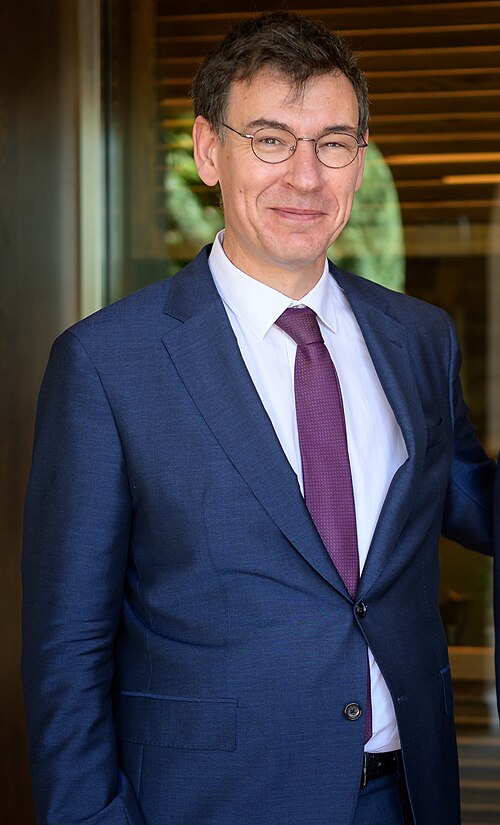 Philippe Baptiste
Transcription Whisper (large-v3), avec identification des locuteurs. À recouper avec la source d'origine.
Analyse automatique
Générée par IA — peut contenir des erreurs. Méthodologie
Chapitres
Répartition du ton (temps de parole politique)
Propositif 95 %Attaque 3 %Défensif 2 %
Questions et réponses
Taux de réponse directe : 100 % (directe = 1, partielle = 0,5, éludée = 0)
- 1:09OuverteRéponse directe
Pourquoi l'espace est-il désormais si important pour l'indépendance et l'avenir de l'Europe ?
- 2:59OuverteRéponse directe
À quoi ressemblerait une politique spatiale européenne réussie dans 10 ans ?
- 4:38OuverteRéponse directe
Comment renforcer l'autonomie stratégique de l'Europe dans l'espace tout en restant ouvert à la coopération internationale ?
- 5:06OuverteRéponse directe
Faut-il une préférence européenne pour l'industrie spatiale ?
- 6:31OuverteRéponse directe
Qu'est-ce qui freine aujourd'hui une intégration plus poussée au niveau de l'UE dans l'espace ?
- 8:40OuverteRéponse directe
Que peut-on attendre de la conférence spatiale de Paris en juillet ?
Temps de parole
- Philippe Baptiste71 %
- Invité20 %
- Présentateur5 %
- ?4 %
≈ 24 interruptions / 10 min (chevauchements et interjections détectés).
Modèle mistral-small-latest · prompt v1 · les citations sont vérifiées mot pour mot dans le transcript ; le taux de réponse directe est calculé à partir des verdicts question par question. Aucun label idéologique n'est produit.
So, welcome back to the Gold Hall. Now that we've had our lunch break, it's time to kick things off this afternoon with a series of keynotes and sessions. It's a great honour to invite on stage our next distinguished speaker, the Minister of Higher Education, Research and Space of France, Mr. Philippe Baptiste, who will be in conversation with Alice Tidy, Senior Defence Reporter at Euronews. Welcome, Minister, and Alice, it's over to you.
Thank
you.
Thank
you.
Is
this working? Yes.
Good
afternoon, everyone, and welcome to this conversation with Mr. Baptiste. Mr. Minister, thank you very much for joining us.
Thank you very much for your invitation.
So, in the interest of time, you've only got 10 minutes with us. Let's just crack on with the questions. So, the main message we've heard this morning so far is that Europe is at a turning point and that space is absolutely crucial for Europe to be more sovereign and more secure and that we need to think more European and not just national. So, why is space now so important to Europe's ability to be more independent and to shape its own future?
Okay,
so let me come back perhaps a few seconds on the rationale of that. I mean, the world is changing very fast. I'm sure that all the speakers have spent some minutes to say a few things about that. But our ally, our very strong ally, well, that used to be our very strong ally, is now very unpredictable. And this has, of course, consequences. This has impact
on
all our defence and security programmes. And, of course, space is part of that.
So,
this means that in practice, we do have to change the way we think space. And this range from reaching space, so meaning launchers, but also to the satellites and to the defence and security programmes that we have in space. And this, of course, is on top of our agenda today, like all European nations, because we all know that the space component for defence is absolutely crucial. So, we have to be more efficient, we have to be more European, and more European, let me be very clear, it means that we need to have access, so launchers, that are launchers that are 100% European, that are ETA-free launchers with no kill switch, and the same for all the components.
So, typically, telecommunication constellations that we are, you know, this is a very hot topic today for Europe. We need a European constellation with European hardware, with full sovereignty on all the components. This is a clear objective for Europe and for France.
So,
as we start shaping this European space policy, as all these discussions are happening, obviously, this is happening now, today, but say you have a crystal ball, you can look 10 years in the future, what would a successful European space policy look like for you in political, in industrial, or even in strategic terms?
A
powerful and responsible
Europe for
space and for defence, meaning that able to lead its own strategy, its own defence strategy with respect to its neighbour, with full respect, of course, with our allies, but Europe, which is much more in charge than it is today, that's my view, and this is true for defence, but this is true also for the space sector.
It does not mean that within the next 10 years, we will invest similar amount of money as the US, for instance, or as China on all topics of space, I'm pretty sure that the priorities right now are very clear, they are around defence and security, but at least on this segment, we have to catch up and we have to be strong, we have to be proud of what we are doing, and we need to rely on our own forces. You know, we are a set of nations, a set of powers, and all together, we are a very strong player in the field. We have to realise that, we have to be proud of that, and we have to lead the way.
Okay,
great. So you've already mentioned that we've gone through a lot of great geopolitical upheavals in recent years, so how can Europe strengthen its strategic autonomy in space while keeping an open, cooperative approach internationally? Is that, are you championing a European preference? Is that okay to keep the European space industry competitive? Or like, how do we manage, how do we balance these two things?
That's a good question. I think the answer is not the same depending on the kind of space we are talking about. If we are talking about exploration, if we are talking about science, if we are talking about Earth observation for climate, these topics are very important. And, of course, we need to carry on international cooperation. France has led programmes with all space powers worldwide, ranging from Russia, China, the US, with Japan, with India, and all other partners, and we are very proud of that.
And
these, of course, are scientific programmes, and we shall carry on that.
But
on other topics that, on which our security depends on, then, yes, we need to be more European, and we need 100% European preference. I mean, this is not a question. I mean, where do, how can we imagine that we would use European money only to buy and to develop foreign partners? That's not what we should do. What we should do is use our European money to develop the European industry.
And
I'm very open to the fact that this should be in a competitive approach. Let the best win, and I'm not saying that, you know, I'm very open to that, but this should be European players.
So
what are the main things today hindering deeper concentration at the EU level? Is it a lack of political will? Is it that communication between member states and EU institutions or with industry is not going well? What is it that's hindering this
deeper
integration and this,
you
know, the development of this European space policy?
I
think, first of all, I think that we are improving, and we are learning very fast, and we have to be very thankful to the President of the United States, who helps us every day on this topic. No, but seriously, I mean, I think that we are improving. I do think that, I mean, the European, the EU should be really leading the political future of space in terms of vision, in terms of programs that should be developed. Because this is the right place where we should see that. And then after, we have to work on all the technicalities behind, to be sure that we can implement this program in an efficient way.
And
we have a lot of work to do. I mean, I've, several times, I've expressed myself on topics like geographical return and so on,
and
I know this is not a view. I think that
it's
a burden more than an asset for Europe.
But
I know very well that this opinion is not shared by everyone, and I'm fully aware of that. But we should find mechanisms that are more efficient than what we have today.
To
be sure, of course, that there is some kind of fair return for all countries that put money on the table and so on.
And
yes, of course, I mean, all countries do that, even in the U.S. today. If you ever look to the way the workload is distributed along the different states, takes into account their contribution. So, yes, of course, we should do something like that. But it should be more clever than what we are doing today. We should improve the system. And I just want to take this opportunity to say that this will be one of the topics that we will discuss at the International Space Conference that we will host in Paris in the two first weeks of July this year.
So,
my last question will be on this conference. So, you're hosting this conference in July, as you mentioned. So, what can we expect from it? What will success look like from this conference?
Just to briefly frame it,
I
mean, we will discuss, of course, some scientific and international scientific programs. So, we hope, of course, to have all big space players worldwide around the table, and it looks like it will be the case, yes. We will discuss, of course, some regulation topics that are crucial today, where all space players have to be around the table, and especially the two big ones.
And
we really hope to have everybody around the table to discuss regulation around the question, of course, I mean, regulation on traffic regulation and traffic control in space, but also on questions related to frequencies and the way they are handled today. So, those are questions that we will put on the table. We will also have some defense and security questions that will be discussed. And, finally, we will also have a chapter dedicated to Europe and to the way, I mean, Europe today is working on our
current
program and the way we should do better tomorrow. And, of course, I mean, the European Commission will have a key role for this.
And
so, the U.S. and China have confirmed they will be attending, because the two players, the two big players you mentioned, have got to be them.
Informal discussions are going on today, and I'm pretty confident.
All
right. Well, thank you very much for your time today, Mr. Minister. It was a pleasure.
Thank you very much.
Thank
you once again, Minister. Thank you, Alice, for leading that discussion. Thank you.