An EU of six, not 27, best way to 'reinforce Europe', Bruno Le Maire tells Euronews
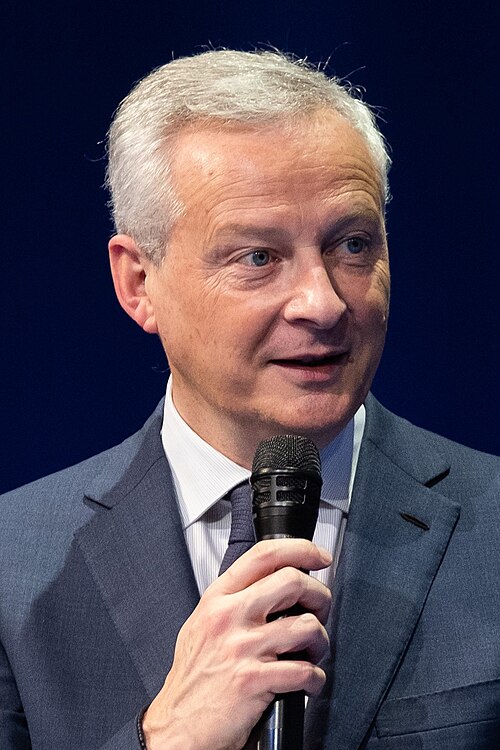 Bruno Le Maire
Transcription Whisper (large-v3), avec identification des locuteurs. À recouper avec la source d'origine.
Analyse automatique
Générée par IA — peut contenir des erreurs. Méthodologie
Chapitres
Répartition du ton (temps de parole politique)
Propositif 60 %Attaque 30 %Défensif 10 %
Questions et réponses
Taux de réponse directe : 93 % (directe = 1, partielle = 0,5, éludée = 0)
- 0:13OuverteRéponse directe
Vous étiez au G7 en 2019 et vous connaissez exactement comment cette machine fonctionne. Je voulais vous demander à expliquer, il y a une déclaration jointe sur l'Ukraine. Qu'est-ce que vous faites de ça?
- 1:34OuverteRéponse partielle
I don't want to spend too much time on President Trump, but he is going to a dinner in Versailles. Was that a step needed in terms of diplomacy to get this deal done?
- 2:13RelanceRéponse directe
And you say this is a fake deal. Why is that? The Europeans have welcomed that as a breakthrough.
- 4:24OuverteRéponse directe
Mr. Le Maire, on a broader line, you have said at times that the way that Trump negotiates, and you have seen it firsthand because you were involved directly in those talks, is sometimes and oftentimes brutal. Is this G7 a moment of reconciliation, or would you say, ultimately, Trump has not changed, the Europeans need to push for their own interests?
- 6:29RelanceRéponse directe
You say, Europe, forget about unity at 27, go to six countries. How would that work?
- 7:35RelanceRéponse directe
Is there political consensus to do that? And I say that because your own country is heading into a very polarizing election next year.
Affirmations vérifiables (citations exactes)
- 0:49Invité politiqueFait
« The fact that G7 countries seem to be able and ready to provide long-range missiles to Ukraine is quite good news. »
- 0:59Invité politiqueFait
« The fact that the United States of America stand ready to trigger new economic sanctions against Russia is also good news to put that war to an end, to a ceasefire, and to really put a limit to Vladimir Putin. »
- 1:17Invité politiqueFait
« I also think that on the global imbalances, France and Macron were right to underline that these global imbalances between the U.S., Europe, and China are not for the benefit of all the countries in the world and must be changed. »
- 2:24Invité politiqueFait
« No, it's not a good deal. And I disagree on that point. I would use the title of a famous play, which is Much Ado About Nothing. »
- 2:35Invité politiqueFait
« The United States decided to trigger the war against Iran. And I think that after the deal, Iran is stronger than before the war. »
- 2:59Invité politiqueFait
« There are only words, but there are not very strong technical commitments on the fissile materials and on the best way to prevent Iran to get access to the nuclear weapon, which is the absolute key and the absolute worry of all countries around the world. »
- 3:27Invité politiqueFait
« You know that the southern part of Europe could be hit at some point by those missiles. »
- 3:48Invité politiqueFait
« Well, having a deal is always better to have a war. But we must be lucid that this month of war have reinforced the Iranian regime and reinforced Iran in the region. »
- 5:00Invité politiquePromesse
« And they don't need to be united with the 27 member states. They need to give a new impetus to the European construction by building a European with six core countries, France, Germany, Italy, Spain, Poland, and the Netherlands. »
- 5:50Invité politiqueFait
« The way President Trump and the U.S. administration is explaining, well, you should get rid of the taxation of Google, Amazon, Facebook, and Microsoft. Otherwise, I will hit you with new tariffs, is 100% unacceptable among allies. »
- 6:30Invité politiqueFait
« You know, 27 countries means long talks and very few decisions. We need strong decisions and less talks. »
- 7:55Invité politiqueFait
« Either we stand with a decision-making process with 27 member states, the commission, we do not really know who is responsible for what. »
- 9:20Invité politiqueFait
« Well, of course, we should avoid any kind of trade war with China. »
- 9:47Invité politiqueFait
« The first one is that if there has been some heavy public subsidies to one or two sectors, like the automotive industry, China will have to pay to sell its cars on the European soil and in the single market. »
Temps de parole
- Bruno Le Maire77 %
- Présentateur15 %
- ?7 %
≈ 61,8 interruptions / 10 min (chevauchements et interjections détectés).
Modèle mistral-small-latest · prompt v1 · les citations sont vérifiées mot pour mot dans le transcript ; le taux de réponse directe est calculé à partir des verdicts question par question. Aucun label idéologique n'est produit.
Bruno
Le Maire, merci beaucoup pour nous rejoindre. Vous êtes le
ministre de France
de France,
le ministre
de
France.
Vous étiez au G7 en 2019 et vous connaissez exactement comment cette machine fonctionne. Je voulais vous demander à
vous
expliquer, il y a une déclaration jointe. Il n
'est
pas clair qu'il y
aurait
une, mais il y a une déclaration
jointe,
surtout sur l'Ukraine. Qu'est-ce que vous faites de ça?
Je pense que la déclaration
final
des G7 est très forte et une très bonne.
Tous
les points que nous avons sur l'Ukraine sont vraiment significatifs et montrent la supporte des G7 pays à l'Ukraine et à l'opposition à l'attack
de l
'Ukraine.
The
fact that G7 countries seem to be able and ready to provide long-range missiles to Ukraine is quite good news. The fact that the United States of America stand ready to trigger new economic sanctions against Russia is also good news to put that war to an end, to a ceasefire, and to really put a limit to Vladimir Putin.
I
also think that on the global imbalances, France and Macron were right to underline that these global imbalances between the U.S., Europe, and China are not for the benefit of all the countries in the world and must be changed.
I don't want to spend too much time on President Trump, but he is going to a dinner in Versailles. Was that a step needed in terms of diplomacy to get this deal done?
You
know, we all are aware of all of the difficulties that we are facing, the relationship between Europe and the U.S. I was personally very critical against the deal that was made between the United States and Iran, because to me, this is a fake deal.
But
I think that this is in the global interest of all these seven members to stand united to face the challenges of the 21st century, especially the question of economic imbalances with China.
And
you say this is a fake deal. Why is that? The Europeans have welcomed that as a breakthrough. In fact, they salute, and that's a quote, the strong leadership of the president of the U.S. Is this really a good deal?
No,
it's not a good deal. And I disagree on that point. I would use the title of a famous play, which is Much Ado About Nothing. The United States decided to trigger the war against Iran. And I think that after the deal, Iran is stronger than before the war.
You
still have these uncertainties about the future of the Strait of Hormuz.
Will
there be a toll or not on the Strait of Hormuz?
You
don't have very strong solutions, and you are not addressing the key question of fissile materials. There are only words, but there are not very strong technical commitments on the fissile materials and on the best way to prevent Iran to get access to the nuclear weapon, which is the absolute key and the absolute worry of all countries around the world. How do we do to prevent Iran to get access to the nuclear weapon? And the third question, which is not addressed in the deal, is the long-range ballistic missiles capacities of Iran.
You
know that the southern part of Europe could be hit at some point by those missiles. Not addressing the threat posed by the Iranian missiles is, to me, a mistake and could be a threat on the long term.
So,
did the Europeans make a mistake by basically endorsing that deal in the statement?
Well, having a deal is always better to have a war. But we must be lucid
that
this month of war
have
reinforced the Iranian regime and reinforced Iran in the region.
It
was not exactly the strategic purpose of that war. So, to me, this is a failure, and I think that the European countries do have a key role to play to reinforce the commitment of Iran vis-à-vis the nuclear weapons, vis-à-vis the nuclear missile threat, and also vis-à-vis the question, the key question from an economic point of view of the Strait of Hormuz.
And,
Mr. Le Maire, on a broader line, you have said at times that the way that Trump negotiates, and you have seen it firsthand because you were involved directly in those talks, is sometimes and oftentimes brutal. Is this G7 a moment of reconciliation, or would you say, ultimately, Trump has not changed, the Europeans need to push for their own interests?
I
think that the single lesson
that
all the European leaders must draw from the past month, and I would say from the past two years,
is
that if they want to be relevant
and
strong,
they
need to be united.
And
they don't need to be united with the 27 member states.
They
need to give a new impetus to the European construction by building a European with six core countries,
France,
Germany, Italy, Spain, Poland, and the Netherlands. They should put on the table some key issues on which they want to deliver,
either
the question of Iran or the question of Ukraine, or the question of building cheap capacities on the European soil, or the question of energy and nuclear energy. Six countries, instead of 27 countries, is the best way of reinforcing Europe,
of
facing the threats posed by many empires around the world, and to get some concrete results. You know, we cannot accept anymore
to
be blackmailed
by
the U.S. administration.
The
way President Trump and the U.S. administration is explaining, well, you should get rid of the taxation of Google, Amazon, Facebook, and Microsoft. Otherwise, I will hit you with new tariffs, is 100% unacceptable among allies. So if we want to resist that kind of threat and that kind of blackmail, we need to be united. The six strongest
European
member states must stand united.
So
you're saying that blackmail will remain, but you make a strong statement there. You say, Europe, forget about unity at 27, go to six countries. How would that work?
You know, 27 countries means
long
talks
and
very few decisions.
We
need strong decisions and less talks. This is why I really emphasize the necessity to move towards Europe with six core countries, and then the 21 other member states,
if they
want to join, they will join. But first of all, let's move on. Second, the way the U.S. are dealing with Europe
is
not acceptable.
The
way they are
putting
this question of tariffs and this threat of new tariffs against French wines or German automobile industry is something we cannot accept.
But
if we are divided, you cannot resist that pressure. If you stand united, explaining that it will be difficult for the U.S. to get access to the European market if they do not respect Europe as a partner is the best way of getting some concrete results.
And I want to ask you a final question, but I want to pick up on this point because you're pitching now a Europe that would work at six. Is there political consensus to do that? And I say that because your own country is heading into a very polarizing election next year.
Next
year,
you
will have key elections. So I think it's time, 11 months before the national elections in France, to clearly explain to the French people what we want for the future of Europe.
Either
we stand with a decision-making process with 27 member states, the commission, we do not really know who is responsible for what.
And
you cannot get results on key issues like artificial intelligence, the cloud capacities and the production of semiconductors on the European soil just to speak about tech. Or you explain to the French people, well, we want to come back to a Europe
which
is a core Europe
with
six key countries that will be able to deliver concretely on some very specific topics. And you will give the sense
that
Europe can be efficient, that Europe can deliver, that you can get some concrete results. And that standing united, you have the possibility of bridging the gap with China, bridging the gap with the U.S. and resisting the pressure of those countries.
This
is why I really think that it's time to radically change the way Europe has been constructed.
And,
sir, just as a final point, you mentioned economic imbalances. That is a code now for, clearly, China. The way things are going, it seems to me a trade war between the EU and China is inevitable and maybe even necessary. How do you deal with a power like China?
Well, of course, we should avoid any kind of trade war with China.
But
we must be respected by the Chinese government and by President Xi Jinping,
which
means that you must explain to China, being once again united, the six key countries, that China cannot get access
to
the single market
without
taking some decisions and without abiding by rules.
The
first one is that if there has been some heavy public subsidies to one or two sectors, like the automotive industry, China will have to pay
to
sell its cars on the European soil and in the single market. Second, we must put in place a rule of European content and a real rule of European content, not the one extended to 90 other countries, but a rule of European content limited to the single market and to the European producers. Third, we need a transfer of technologies.
And
we need to explain to our Chinese partner that it is time for us to get access to some technologies that we urgently need to improve our productivity and our competitiveness.
In
the field of
batteries,
for instance, electric batteries, we need the technologies of China and we need the cooperation of China. So the deal would be you can get access
to
the European single market
with
the 450 million consumers,
but
under some conditions, European content, transfer of technologies and tariffs in the case, a sector has been heavily subsidized by the Chinese government. This is what I would call a new level playing field between China and Europe.
A
very last point, but which is absolutely key that must be addressed at the level of the G7 with the United States, Europe and all the Western countries is the fact that
the
Chinese currency
is
underestimated and underrated. This poses huge problem for the competitiveness of the European and the US industry. So we must address this question of the level of the Chinese currency and the fact that for the time being, it is under evaluated and it gives to China the possibility of exporting far quicker and far better its products to either the US or to Europe.
So
a new level playing field, Mr. Lamer. Thank you so much for joining us on this important G7.
Thank you so much. Thank
you very much.